Sandi Spots
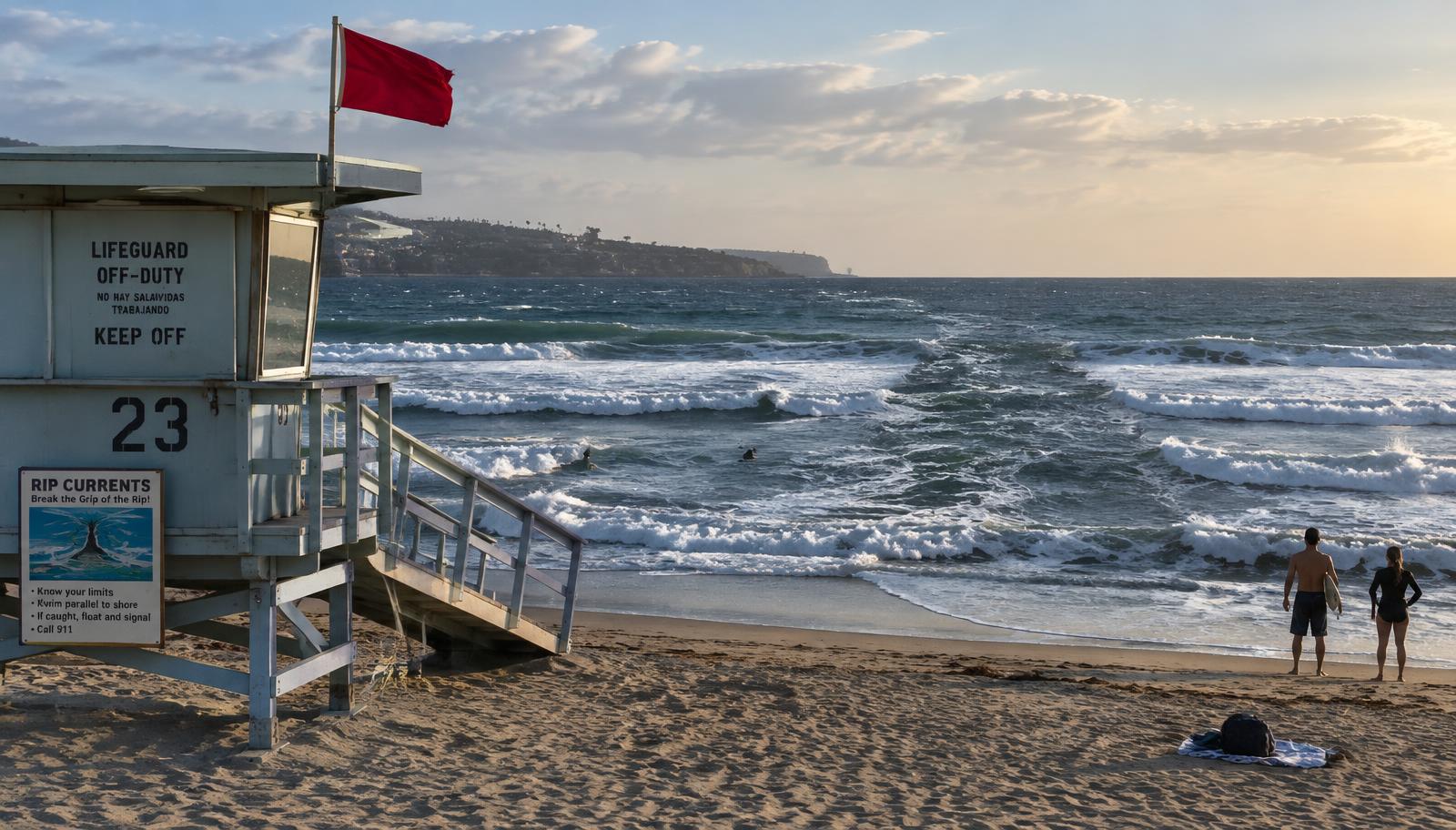
    Red warning flag flying on a San Diego lifeguard tower above choppy surf

    Rip Currents and Beach Flags in San Diego

    Rips are the reason lifeguards make most of their rescues here. They are also the easiest hazard to read in advance.

    Last updated

    Quick answer

    Two different flag systems fly on San Diego County beaches, which is why visitors get confused. On City of San Diego beaches, the flag people see most is a black-and-yellow checkered flag, and it is not a hazard warning at all — it marks the boundary between the designated swimming zone and the surfing zone. Coronado, which runs its own lifeguard service, does publish a colour system: green means safe to swim with normal care, yellow means rough conditions and extreme caution, one red flag means a serious hazard such as high surf or dangerous currents, two red flags mean the water is closed to swimming, and purple is a stingray warning. Before you drive, check the National Weather Service surf zone forecast for San Diego County, which publishes a rip current risk of low, moderate or high for the coastal stretch. If you are caught in a rip, the official advice is the same everywhere: do not fight it, float and stay calm, swim parallel to the shore to get out of the channel, then angle back in, and if you cannot, tread water and wave and shout for help. Swim in front of a staffed tower — the City staffs nine oceanfront stations year-round, generally 9am to dusk, and adds seasonal towers in summer.

    What the flags mean, and whose beach you are on

    FlagMeaningWhere
    Black and yellow checkeredBoundary between the swimming zone and the surfing zone — a zoning marker, not a hazard warningCity of San Diego beaches
    GreenSafe to swim, with normal careCoronado
    YellowRough conditions, not life-threatening — extreme cautionCoronado
    One redSerious hazard: high surf or dangerous currents. Swim with extreme cautionCoronado
    Two redWater closed to swimmingCoronado
    PurpleStingray warningCoronado
    White sign at the access pointCounty bacteria advisory — swimming not recommendedCountywide, posted by the County

    Rates and availability change daily, so we link the guide rather than quote a price. Each page compares walkable, short-drive and budget options with parking and resort fees called out.

    How to read the day before you go

    The surf zone forecast

    The National Weather Service's San Diego office publishes a rip current risk of low, moderate or high for San Diego County coastal areas in its surf zone forecast, alongside surf heights. It is the single most useful thing to check on a beach morning. Checked 20 September 2026.

    Bigger swell means stronger rips

    Rips are fed by water that waves push onshore finding a channel back out. A long-period south swell in summer or a winter northwest swell both raise the risk, even on a warm, still, inviting-looking day.

    Look for the gap in the waves

    From the sand, a rip often shows as a darker, calmer-looking lane where the waves are not breaking, sometimes with foam or sand streaming seaward. The flat-looking water is the part to avoid, not the part to swim in.

    Jetties, piers and reefs concentrate them

    Rips set up reliably alongside hard structures — the Ocean Beach pier, the Crystal Pier, jetties at Mission Bay's entrance and the reefs off La Jolla. Give structures a wide berth with children in the water.

    Ask the tower

    Lifeguards will tell you where today's rip is and where to put your towel. They would far rather answer than swim out to you.

    If you are caught in one

    Do not fight it

    A rip pulls you out, not under. Swimming straight back at it is how strong swimmers exhaust themselves, and exhaustion is what turns a rip into a drowning.

    Float and stay calm

    Official advice from NOAA and the United States Lifesaving Association is to float first, get your breathing under control and keep your head above water.

    Swim parallel to the shore

    Rips are usually narrow. Swim along the beach to get out of the channel, or angle across with the waves, then head back in once you are clear of it.

    Signal if you cannot get out

    Tread water or float and wave one arm and shout. On a staffed beach that is faster than any swim you can manage.

    Do not swim out after someone

    Most double drownings are rescuers. Alert the lifeguard, call 911, and throw or point them at anything that floats.

    If in doubt, do not go out

    The oldest line in surf safety and still the correct one, particularly at an unstaffed beach or outside tower hours.

    Water quality is a separate warning system

    Rain advisories

    The County issues a general rain advisory when about a fifth of an inch of rain or more falls, and recommends staying out of the water for 72 hours after the rain stops. These advisories are not signposted at the beach, so it is on you to check.

    Bacteria advisories

    When testing exceeds standards, the County posts white warning signage at the affected beach. Swimming is not recommended, but the beach stays open.

    Closures

    Closures are reserved for confirmed sewage impacts, most often in the South Bay after transboundary flows. These are enforced, not advisory.

    Red tide

    Why the water sometimes turns brown by day and glows blue at night, and whether it is a health issue.

    Where the lifeguards are

    How to check this before you rely on it

    • • The checkered swim-and-surf-zone flag and year-round staffing at nine oceanfront stations come from the City of San Diego Lifeguard Service's own beach regulations and department pages, checked 20 September 2026.
    • • The green, yellow, red and purple flag meanings are the City of Coronado's published system. Do not assume they apply on City of San Diego sand.
    • • The rip current risk levels come from the National Weather Service San Diego surf zone forecast. Escape advice follows NOAA and United States Lifesaving Association guidance.
    • • Rain advisory, bacteria advisory and closure rules come from the County of San Diego's Beach and Bay Water Quality Program.
    • • Conditions change hour to hour. Nothing on this page replaces the lifeguard on the beach you are standing on.

    Frequently asked

    What do the beach flags mean in San Diego?

    It depends whose beach you are on. On City of San Diego beaches the common black-and-yellow checkered flag marks the line between the swimming zone and the surfing zone rather than warning of a hazard. Coronado runs a colour system: green for safe, yellow for rough, one red for a serious hazard, two red for water closed to swimming, and purple for stingrays.

    How do you get out of a rip current?

    Do not fight it. Float, stay calm and get your breathing under control, then swim parallel to the shore to get out of the channel before angling back in. If you cannot escape it, tread water and wave one arm and shout for help.

    Where can I check the rip current risk in San Diego?

    The National Weather Service's San Diego surf zone forecast publishes a rip current risk of low, moderate or high for San Diego County coastal areas, alongside surf heights. Check it the morning of your beach day.

    Are San Diego beaches lifeguarded all year?

    The City of San Diego staffs nine oceanfront stations year-round, generally from 9am to dusk, and adds seasonal towers in summer. Our beach database currently lists 7 beaches with a year-round tower. Plenty of beaches, including most North County stretches outside summer, have no one watching.

    How long after rain should you stay out of the ocean in San Diego?

    The County recommends 72 hours after the rain stops, and issues a general advisory when about a fifth of an inch or more falls. Those advisories are not signposted at the beach, so check the County's water quality page yourself.

    Which San Diego beaches have the strongest rip currents?

    Rips are conditions, not places, but they set up reliably beside structures — the Ocean Beach and Crystal piers, the jetties at the Mission Bay entrance and the La Jolla reefs. On a big swell, expect them anywhere along the open-ocean beaches.

    Keep reading

    The Sandi Spots Newsletter

    San Diego, in your inbox.

    New beach finds, hidden taco shops, weekend events, and seasonal guides — once a week from a local. No spam, ever.

    One email a week. Unsubscribe anytime.

    About this guide

    Written and fact-checked by the Sandi Spots Editorial team — San Diego residents publishing under Sleep Coast LLC. Every place we recommend has been visited in person or verified against an official source, and no business can pay for inclusion or a higher ranking.

    Local, first-hand. Reported on the ground in San Diego County.
    Kept current. Prices, hours, and closures reviewed on a rolling basis.
    Independent. Affiliate links never influence rankings.

    Editorial policy · About us · Suggest a correction