History
How the 1915 Expo Built the Balboa Park You See Today
When the Panama Canal opened in 1914, every Pacific coast city wanted to be the first US port that ships saw. San Francisco won the official world's fair. San Diego — population 39,000, a fraction of the size — threw its own anyway. The Panama-California Exposition opened on January 1, 1915, ran for two years, and built the architectural identity San Diego still wears today.
Bertram Goodhue's Spanish dream
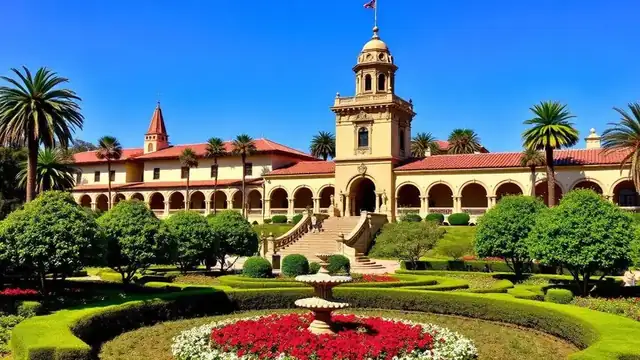
The expo's chief architect, Bertram Grosvenor Goodhue, threw out the original neoclassical plan and proposed something nobody had built in California before: Spanish Colonial Revival, blending Mexican Churrigueresque, Mission, and Moorish elements. The buildings were essentially stage sets — wood frames covered in plaster ornamentation — designed to last a year. Instead, they defined a regional style that spread across the entire Southwest.
The buildings that survived
California Building & Tower (1915) — Goodhue's masterpiece, now home to the Museum of Us. The 200-ft tower is the most-photographed structure in San Diego.
Casa del Prado — The current building is a 1971 reconstruction; the original was condemned after the 1968 earthquake.
Botanical Building (1915) — One of the largest lath structures in the world. Free to enter.
Spreckels Organ Pavilion (1915) — Home of the largest outdoor pipe organ in the world. Free Sunday concerts have run since 1915 without interruption.
Cabrillo Bridge (1914) — The expo's grand entry, a 1,500-ft concrete arch bridge. Still the main entrance from 6th Avenue.
Why it almost got demolished
By 1920, the temporary buildings were crumbling. The city council voted multiple times to bulldoze the entire expo grounds. Each time, women's clubs and a small group of preservationists raised emergency funds to patch the plaster. In 1935, San Diego threw a second world's fair (the California-Pacific International Exposition) in part as an excuse to repair the 1915 buildings. That second fair added the Old Globe Theatre, the Spanish Village Art Center, and the Federal Building (now the Hall of Champions).
The naming of Balboa Park
The park was officially called 'City Park' until 1910, when a public contest renamed it after Vasco Núñez de Balboa, the Spanish explorer who first sighted the Pacific Ocean from the Americas in 1513. The name was chosen specifically to set up the 1915 expo's Pacific-coast theme.
Kate Sessions planted it first
The park was bare scrub until horticulturist Kate Sessions struck a deal with the city in 1892: she could use 32 acres as a commercial nursery if she planted 100 trees a year in the park and 300 more around the city. Over three decades she introduced the jacarandas, eucalyptus, birds of paradise, and queen palms that now read as quintessentially San Diegan. The landscape people photograph in Balboa Park is not native — it is Sessions' inventory, matured for a century. She is the only reason the 1915 buildings sit in a forest instead of a dust bowl.
The exposition's uglier exhibits
The 1915 fair also carried the era's racial pseudoscience. The Science of Man exhibit in the California Building presented physical-anthropology displays organized around theories of racial hierarchy, and the Painted Desert concession employed Native people as a live 'authentic village' attraction for paying visitors. The Museum of Us — the same building — now addresses this history directly and has led repatriation work under NAGPRA. It is worth knowing before you walk in.
The 1935 fair, then wartime hospital duty
The California-Pacific International Exposition of 1935–36 added the Old Globe Theatre, the Spanish Village Art Center, the Federal Building, and the Ford Building (now the Air & Space Museum). Then twice — in both world wars — the Navy took the park over as a hospital and training campus, filling the Prado with hundreds of temporary barracks. Sailors were housed in the buildings that had displayed art two decades earlier; several structures never recovered and were rebuilt in the 1960s and 70s in permanent concrete.
The park today
Balboa Park is 1,200 acres — 200 acres larger than Central Park — and contains 17 museums, the San Diego Zoo, the Old Globe, and the largest free outdoor organ pavilion in the world. Free Tuesdays rotate through the museums on a published schedule. The Tower After Hours tour ($30, monthly) is the only way to climb the California Tower itself.
For the full visitor's playbook, see our Balboa Park topic page and our guide to free things to do in San Diego.