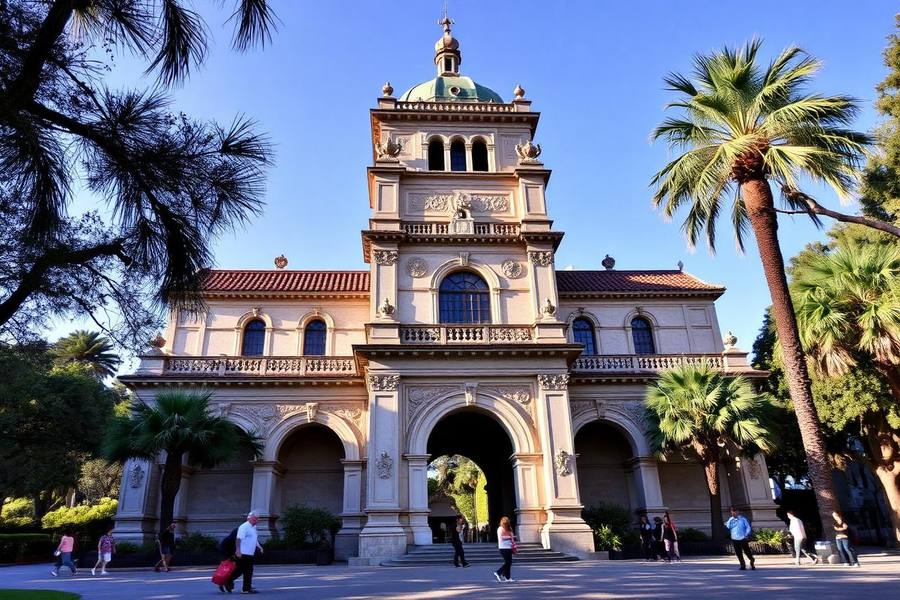
California Building and Tower
El Prado · 1915
The park's signature silhouette, built as the fair's centerpiece and now the Museum of Us. Tower climbs are ticketed separately and worth booking ahead.
We use cookies for essential site functions and, with your permission, for analytics and advertising. California residents can opt out of the sale or sharing of personal information at any time. See our Privacy Policy, Cookie Policy, and Do Not Sell or Share My Personal Information.
A world's fair built out of plaster, scheduled for demolition, and rescued twice.
Last updated
Balboa Park's most surprising fact is that most of it was never meant to survive. The ornate Spanish Colonial Revival buildings along El Prado were built for the 1915 Panama-California Exposition out of temporary materials — plaster over wood frame — and were scheduled to come down when the fair closed. San Diegans refused, and a century of piecemeal rescue, rebuilding in permanent materials and outright reconstruction followed. A second fair in 1935 added more buildings and the Spanish Village. Along the way the park hosted a Navy hospital in both world wars, nearly lost the Botanical Building, saw the Old Globe burn down in 1978 and get rebuilt, and grew into the largest urban cultural park in the United States, with 17 museums, the zoo and 1,200 acres. The 1,400 acres were set aside in 1868, before the city had much of anything else — that decision is the real origin story.
| Year | What happened | What survives |
|---|---|---|
| 1868 | 1,400 acres set aside as city park | The park boundary itself |
| 1915 | Panama-California Exposition opens | El Prado, California Tower, Botanical Building |
| 1917-19 | Navy takes the park as a hospital | Nothing visible; the buildings survived because of it |
| 1935 | California Pacific International Exposition | Spanish Village, Old Globe, Municipal Gym |
| 1978 | Old Globe destroyed by arson | Rebuilt and reopened in 1982 |
| Today | 17 museums, the zoo, 65+ organizations | Largest urban cultural park in the US |
Rates and availability change daily, so we link the guide rather than quote a price. Each page compares walkable, short-drive and budget options with parking and resort fees called out.
El Prado · 1915
The park's signature silhouette, built as the fair's centerpiece and now the Museum of Us. Tower climbs are ticketed separately and worth booking ahead.
El Prado · 1915
One of the largest lath structures in the world, built from redwood strips. It has been on the brink of demolition more than once and reopened after a multi-year restoration.
East of El Prado · 1935
Built for the second fair, used as Army barracks in WWII, and now 200-plus working artists in 37 studios. Free to walk through, and the tile courtyard is the most photographed floor in the park.
Central Mesa · 1935, rebuilt 1982
Built for the 1935 fair as a Shakespeare venue, slated for demolition, saved by locals, then lost to arson in 1978 and rebuilt. Now a Tony-winning regional theater.
Central Mesa · 1914
Home to one of the world's largest outdoor pipe organs, donated by the Spreckels brothers. Free Sunday concerts have run for over a century.
West entrance · 1914
The cantilever bridge that carries you into the park over the canyon. It was the first multiple-arch cantilever bridge in California.
Balboa Park · 1916
The San Diego Zoo grew out of animals abandoned after the 1915 exposition, gathered up by a local doctor who heard a lion roaring from the fairgrounds.
Balboa Park · 1917 and 1941
The Navy occupied the park twice. Ironically, military maintenance is part of why the temporary buildings lasted long enough to be saved.
Balboa Park · 1910
For its first four decades it was simply 'City Park.' The name was chosen in a public contest ahead of the exposition.
West of Pan-American Plaza · Quiet
A eucalyptus grove planted from the park's earliest tree-planting campaigns, and still the emptiest place in the park on a busy Saturday.
Balboa Park · Trails
Florida Canyon and the park's other ravines preserve the original coastal sage scrub the whole mesa once looked like — 65 miles of trails run through them.
The 1915 Panama-California Exposition buildings were built with temporary materials — plaster over wood frames — and the plan was to remove them after the fair. Public pressure saved them, and most were later rebuilt in permanent materials.
The city set aside 1,400 acres for the park in 1868, decades before the exposition. It was called City Park until 1910.
From animals left behind after the 1915 exposition. Dr. Harry Wegeforth organized their care and founded the Zoological Society of San Diego in 1916.
The gardens, El Prado architecture, Spanish Village Art Center, the canyon trail system, Sunday organ concerts and the Timken Museum are all free. Most other museums are ticketed.
The Sandi Spots Newsletter
New beach finds, hidden taco shops, weekend events, and seasonal guides — once a week from a local. No spam, ever.
One email a week. Unsubscribe anytime.
Published by the Sandi Spots Editorial team at Sleep Coast LLC. Guides combine local perspective and source research. Check the individual guide for firsthand observations and follow official links to confirm current details.