History
Chicano Park and the 12-Day Sit-In That Saved a Neighborhood
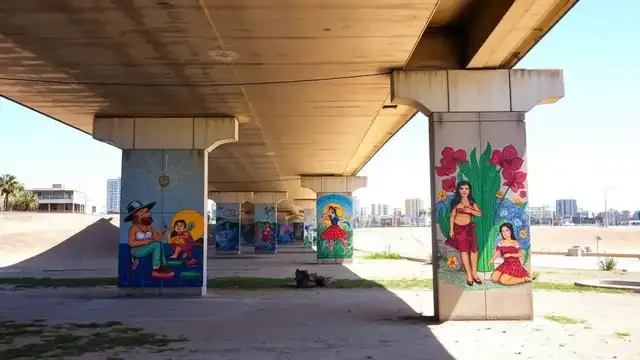
Chicano Park sits under the eastern approach to the Coronado Bridge in Barrio Logan, just south of downtown San Diego. Its 80+ outdoor murals — painted across freeway pillars, abutments, and walls — make up the largest collection of Chicano art in the world. In 2017, it became a National Historic Landmark, one of only a handful nationwide. The park exists because of a 12-day standoff in April 1970.
How a neighborhood lost its waterfront
Barrio Logan was the largest Mexican-American neighborhood in San Diego from the 1890s through the 1950s. Then two state projects cut it in half: Interstate 5 in 1963 sliced off the eastern edge, and the Coronado Bridge in 1969 carved a concrete arch through the middle. Roughly 5,000 residents were displaced. The state had promised the empty land under the new bridge would become a community park.
The April 22, 1970 occupation
On the morning of April 22, 1970, residents arrived at the bridge site to find bulldozers preparing the lot — not for a park, but for a California Highway Patrol substation. Within hours, students, mothers, and dock workers walked off jobs, joined hands around the bulldozers, and started planting flowers in the dirt. They brought folding chairs and stayed. The occupation lasted 12 days. The state caved. The CHP substation moved; the park was funded.
The murals begin
In 1973, a group of artists led by Salvador Torres proposed painting the bare concrete bridge pillars. The first mural — 'Historical Mural' on Pillar 7 — went up in a single weekend with paint donated by local hardware stores. Over the next five decades, more than 80 murals were added by artists including Mario Torero, Victor Ochoa, and the collective Toltecas en Aztlán. The murals depict Aztec gods, farmworker rights, the Brown Berets, the Virgen de Guadalupe, and the original 1970 takeover itself.
The 2017 National Historic Landmark designation
For decades, the park was a hyperlocal treasure that few outside San Diego knew about. In 2013, residents began the federal nomination process. In January 2017, the National Park Service designated Chicano Park a National Historic Landmark — the first park in the country to be recognized for its role in the Chicano civil rights movement. Less than 3% of all sites on the National Register receive this designation.
How to visit respectfully
The park is free, open daily, and easy to reach by trolley (Barrio Logan Blue Line stop is one block away). Walk the loop counterclockwise starting at the Logan Avenue entrance — the murals are roughly chronological in that direction. The Chicano Park Museum & Cultural Center on National Avenue (free, donation-based) opened in 2022 and provides essential context. Avoid weekends with private quinceañera shoots; weekday mornings are best for photography. Don't touch the murals — many are decades old and have been restored multiple times by the original artists.
The murals worth finding
Historical Mural (Pillar 7) — the first mural painted, 1973, a compressed history of Mexico and the barrio.
Varrio Sí, Yonkes No — a protest against the junkyards that surrounded the neighborhood for decades.
La Virgen de Guadalupe — the most-photographed pillar in the park, repainted by the original artist.
Chicano Park Takeover — depicts the 1970 occupation itself, including the bulldozers.
Colossus (1974, restored 2012) — an Aztec figure straining under the freeway ramp, widely read as the barrio holding up the state.
The junkyard fight and the 2013 community plan
Winning the park did not end the fight. Barrio Logan spent the next 40 years wedged against shipyard suppliers, metal platers, and junkyards operating next to homes and schools — one of the worst residential air-quality profiles in the county. In 2013 the City Council approved a community plan that finally separated industrial and residential zoning; shipyard interests overturned it by referendum in 2014. A revised plan passed in 2021. The murals about pollution and displacement are not historical — they are about a dispute that is still live.
Kiosko, the pier, and what got built later
The park kept expanding after 1970. The kiosko (open-air stage) anchors the central plaza; a 1.9-acre expansion added grass and play areas in 2011; the Chicano Park Museum & Cultural Center opened in the 1930s-era Bank of Italy building in 2022. Two blocks west, Cesar Chavez Park returned waterfront access to a neighborhood that had lost its bay frontage to industry in the 1950s.
Chicano Park Day
Every year on the Saturday closest to April 22, the park hosts Chicano Park Day — a free festival with Aztec dancers, lowrider car shows, and live music. It draws 30,000 people. If you can only visit Barrio Logan once, make it that Saturday.