Arts & Culture
Chicano Park Mural Walk: A Respectful Self-Guided Tour of Barrio Logan
A 60–90 minute mural walk
Use the community's current mural map for exact locations and follow open public pathways. This is an interpretive sequence, not an official guided tour.
| Time | Focus | Look for |
|---|---|---|
| 0–15 minutes | Orientation | Bridge columns, park layout, community history |
| 15–35 minutes | History and organizing | Mexican History, Huelga Eagle, Liberación |
| 35–55 minutes | Identity, family and culture | Mujer Cósmica, Women Hold Up Half the Sky, Tree of Life |
| 55–75 minutes | Continuing artistic tradition | Restored works and newer murals |
| Optional extra | Museum | 1960 National Avenue; check current hours |
Understand the park before looking for the murals
Chicano Park is not a generic outdoor art museum. It is a community space created through local organizing. Freeway and bridge construction had displaced residents and disrupted Barrio Logan. When construction for a highway patrol facility began on land the community expected to become a park, residents and activists took action on April 22, 1970. The park that followed became a place for art, gathering, political expression and the preservation of community identity.
The National Park Service recognizes the park as a National Historic Landmark, designated December 23, 2016, for both its role in the Chicano civil rights movement and its public art. Understanding those two aspects together makes the visit more meaningful. Read the Steering Committee's account of the takeover before you go; it presents the history from the community's perspective rather than treating the murals as decorative objects.
Begin with the community mural map
Use the map published by the Chicano Park Steering Committee and the documentation linked by the Chicano Park Museum and Cultural Center. The committee notes that new murals have been created since the older 2015 map, and restoration work continues. Accordingly, do not expect every mural to match an old photograph or map label. Use posted signage and the most recent available documentation.
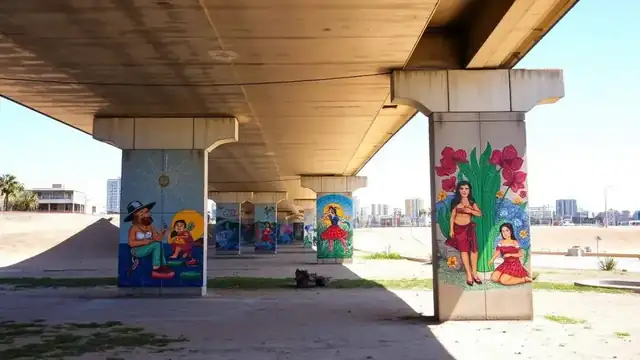
Start on the public pathways around the park near Logan and National avenues. Allow a few minutes to understand the orientation of the bridge supports and the spaces between them. Look up as well as at eye level; some works extend around a column or onto the underside of a structure. Keep out of roadways, closed areas and any space used by artists or maintenance workers.
This itinerary gives you themes and named works to locate on the official map, not turn-by-turn directions through traffic or an independently drawn reproduction of the artwork map. If you need exact accessibility information or want an expert explanation, contact the museum or Steering Committee about a tour.
First theme: community history and political expression
Look for works identified in the committee's documentation as Mexican History, Huelga Eagle and Liberación. They offer an entry into the visual language of history, organizing and resistance. Spend time reading available labels, identifying figures and asking what event or movement the artist is addressing. The historical context matters more than guessing symbolism from appearance alone.
An interesting exercise is to choose one image that uses recognizable historical imagery and another that communicates through symbols or text. Note what you can understand immediately and what requires research. Save questions about particular figures for the museum or a guided tour. Do not claim an interpretation belongs to the artist unless the artist or reliable documentation actually explains it.
Second theme: identity, women, families and generations
Seek out Mujer Cósmica, Women Hold Up Half the Sky and Tree of Life using the mural map. These are starting points for seeing how the park's art encompasses more than the single event that created it. Observe how large-scale composition changes when you stand close to a pillar versus several steps away on a permitted path.
For children, invite them to notice repeated shapes, colors, people and lettering, then read a label together. An adult can help explain that murals express particular historical and cultural perspectives. Give the group time to respond in its own words rather than treating each work as a test of facts. This can make a 45-minute family walk more engaging than a rushed attempt to see every mural.
Third theme: restoration and the park's living history
The committee documents restoration projects and artworks added after its earlier map was created. Look for the updated documentation of works such as Kumeyaay Creation Story and Victoria Contra el Cortito. The specific artists, titles and dates should be taken from the committee's current listing. Do not assume every newer mural is on an old map, or that restoration means a work has lost its original significance.
If a mural is being restored or an event is taking place, yield to the people using the park. Return another day if an area is inaccessible. This is a shared neighborhood space, and visitors are guests. A mural walk should never involve stepping over a barrier, touching artwork, moving objects or interrupting someone working.
Make the museum an optional second stop
The Chicano Park Museum and Cultural Center is at 1960 National Avenue. Its visit page currently lists Thursday through Sunday, 10 a.m. to 4 p.m., with $8 general admission, reduced community and student/teacher admission, and free admission for visitors 18 and younger. Other portions of the museum website show different opening hours, so confirm the schedule directly before travel. The museum is a paid optional addition, distinct from walking through the public park.
Museum exhibits and staff can help you understand the art, the history of the neighborhood and the continuing role of community organizing. Consider an organized tour when traveling with a school, large group or anyone seeking a deeper introduction. The museum directs park tour inquiries to the Steering Committee; contact the appropriate organization rather than assuming a self-guided visit includes a guide.
Practical visiting advice: daylight, transit and accessibility
Plan your visit in daylight and use legal public parking or check the current MTS trip planner for transit to Barrio Logan. Traffic crosses the area, so follow public crossings and do not back into a road while framing a photo. Freeway noise and uneven or obstructed paths can affect the experience; use open, accessible routes and shorten the itinerary as necessary. Bring water and comfortable shoes.
Personal observation and nonintrusive photographs are different from commercial use or organized photography. The museum's mural documentation is explicitly provided for personal, noncommercial use. Do not reproduce its map or images in commercial materials without permission. Ask the appropriate rights holders before commercial filming or reproducing artwork, and respect the privacy of people in the park. This guide links to documentation rather than copying it.
FAQ: how long, how much, and what comes next?
Allow about an hour for a focused walk or 90 minutes for reading, discussion and pauses. A public park walk has no museum ticket cost; a separate museum visit may have an admission fee. If you want to understand the history rather than simply collect photographs, see fewer works and spend more time on each. Pair the visit with a neighborhood bakery or restaurant if you want to support local businesses.
For more historical background, read our existing Chicano Park history article. The purpose of this walking guide is different: helping a visitor connect the physical experience of the murals with the community's own accounts of their creation and preservation.