At least one ADU plus one JADU
On a single-family lot you are entitled to one accessory dwelling unit and one junior ADU, subject to objective standards only.
We use cookies for essential site functions and, with your permission, for analytics and advertising. California residents can opt out of the sale or sharing of personal information at any time. See our Privacy Policy, Cookie Policy, and Do Not Sell or Share My Personal Information.
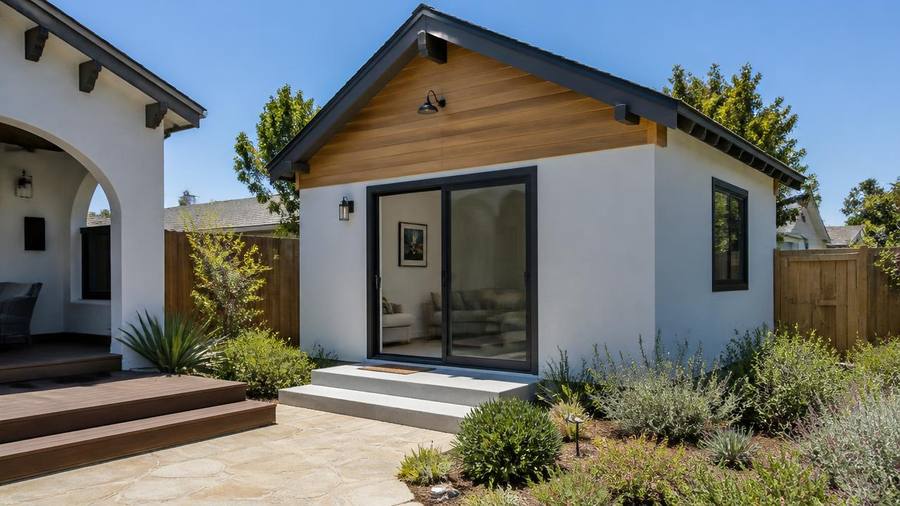
What actually fits, what it costs, and how long the permit really takes.
Last updated
State law forces every California city to allow at least one accessory dwelling unit and one junior ADU on a single-family lot, and San Diego goes further with an ADU bonus program that lets qualifying properties in transit-accessible areas build additional units. A detached new-construction ADU in San Diego typically runs about 250 to 450 dollars per square foot all in, so a 600-square-foot one-bedroom commonly lands between 180,000 and 300,000 dollars including design, permits, and utility work; garage conversions and interior conversions are cheaper, often 120,000 to 220,000. Units up to 800 square feet get statutory protection from restrictive setback and floor-area limits, need only four-foot side and rear setbacks, and cannot be required to add parking near transit. Realistic timelines are three to six months for design and permitting and four to eight months for construction, so plan on a year door to door. The economics work best when the unit is long-term rented — short-term renting an ADU triggers the STRO license rules and its own caps.
| Type | Typical all-in cost | Notes |
|---|---|---|
| Junior ADU (interior conversion) | $90k–$160k | Up to 500 sq ft inside the home, may share a bath, cheapest path |
| Garage conversion | $120k–$220k | Foundation and shell exist; drainage and ceiling height are the usual surprises |
| Detached new build, studio/1BR (400–600 sq ft) | $180k–$300k | Most common backyard build; utility trenching drives cost |
| Detached new build, 2BR (750–800 sq ft) | $250k–$380k | Still inside the 800 sq ft protected envelope |
| Prefab / modular | $160k–$300k | Factory price excludes site work, which often adds 30–40 percent |
| Two-story or above-garage | $300k–$450k | Best for small lots; engineering and access add cost |
Rates and availability change daily, so we link the guide rather than quote a price. Each page compares walkable, short-drive and budget options with parking and resort fees called out.
Much of what a planner used to be able to deny is now protected by statute.
On a single-family lot you are entitled to one accessory dwelling unit and one junior ADU, subject to objective standards only.
A city cannot use lot coverage, floor-area ratio, or open-space rules to block an ADU of 800 square feet or less at 16 feet tall with four-foot setbacks.
If the property is within half a mile of transit, parking cannot be required for the ADU — and converted garage parking does not have to be replaced.
Agencies must approve or deny a complete ADU application within 60 days. Incomplete submittals restart the clock, which is where most delay comes from.
In qualifying transit-priority areas, deed-restricting one affordable unit unlocks additional market-rate units — the main way San Diego lots get three or more homes.
ADUs generally cannot be sold separately from the main house except through narrow qualified-nonprofit programs. Plan to hold, not to subdivide.
Construction is the headline number, but the line items below decide whether a project pencils.
Architectural plans, structural engineering, Title 24 energy compliance, and a survey commonly total 10,000 to 30,000 dollars.
Plan check, building permit, and school facilities fees add up. Impact fees are waived for units under 750 square feet, which is a real reason to stay small.
Water, sewer lateral, and electrical service are the biggest wildcard. A long trench across a deep lot or a panel upgrade can add 15,000 to 50,000.
Adding a dwelling can trigger a capacity fee. Ask about it before you finalize plumbing fixture counts.
Narrow side yards, mature trees, and grade changes force hand-work and small equipment, which prices like custom work.
Hold 10 to 15 percent. Older San Diego housing stock hides knob-and-tube wiring, failing cast-iron drains, and undersized panels.
Every stage below has a normal case and a bad case. Assume the middle.
Confirm zoning, coastal overlay, brush management zone, and setbacks. A one-hour zoning check prevents most dead-end projects.
Plans, structural, and Title 24. Choosing a pre-approved standard plan can cut this stage nearly in half.
Submittal, corrections, resubmittal. Two rounds of comments is normal; coastal or brush-zone parcels take longer.
Four to eight months for a detached build, less for a conversion, plus inspections at foundation, framing, rough-in, and final.
Meter sets and the certificate of occupancy can add weeks after the build looks finished. Don't sign a lease against an optimistic date.
Run the same three numbers every lender and appraiser will.
A detached one-bedroom ADU in a central neighborhood commonly rents in the mid-2,000s to low-3,000s per month; inland and East County are meaningfully lower.
Annual net rent divided by all-in cost. Many San Diego ADUs land in the 8 to 12 percent gross range, which is why the product keeps getting built.
HELOC or cash-out refinance are the common routes; renovation loans and a small number of ADU-specific construction products also exist.
A permitted, legal ADU generally appraises well because it adds rentable square footage. Unpermitted work does the opposite.
New construction is assessed at its added value while the existing home keeps its base — you are not reassessed on the whole property.
Renting the ADU nightly requires a STRO license under the same caps as any other home, so underwrite it as a long-term rental.
Detached new construction generally runs 250 to 450 dollars per square foot all in, putting a typical 600-square-foot one-bedroom between roughly 180,000 and 300,000 dollars. Garage and interior conversions usually land between 120,000 and 220,000.
Units of 800 square feet or less at 16 feet tall with four-foot side and rear setbacks are protected by state law, so that's the practical safe maximum. Larger units are often possible but must satisfy local lot coverage and setback standards.
Not if the property is within half a mile of public transit, which covers much of the city. Where a garage is converted, the lost parking does not have to be replaced.
The agency has 60 days to act on a complete application, but design, engineering, and correction cycles mean three to six months from starting drawings to a permit in hand is the realistic range.
Only with a Short-Term Residential Occupancy license, and whole-home nightly rentals are capped and awarded by lottery. Most ADU owners rent for 31 days or longer instead.
Generally no. Separate conveyance is limited to narrow programs involving qualified nonprofits, so treat an ADU as an addition to your property rather than a future separate sale.
Yes, but only on the added value of the new construction. Your existing home keeps its Proposition 13 base year value.
Tiers, caps, the lottery, and what hosts actually pay.
How to get plans through the city and your association.
Why quotes vary block to block and what to do about it.
Payback math under NEM 3.0, with and without a battery.
What SDG&E, water, and trash actually run per month.
Rates, Mello-Roos, and supplemental bills explained.
What an ADU can realistically rent for in your area.
The Sandi Spots Newsletter
New beach finds, hidden taco shops, weekend events, and seasonal guides — once a week from a local. No spam, ever.
One email a week. Unsubscribe anytime.
Published by the Sandi Spots Editorial team at Sleep Coast LLC. Guides combine local perspective and source research. Check the individual guide for firsthand observations and follow official links to confirm current details.