Sandi Spots
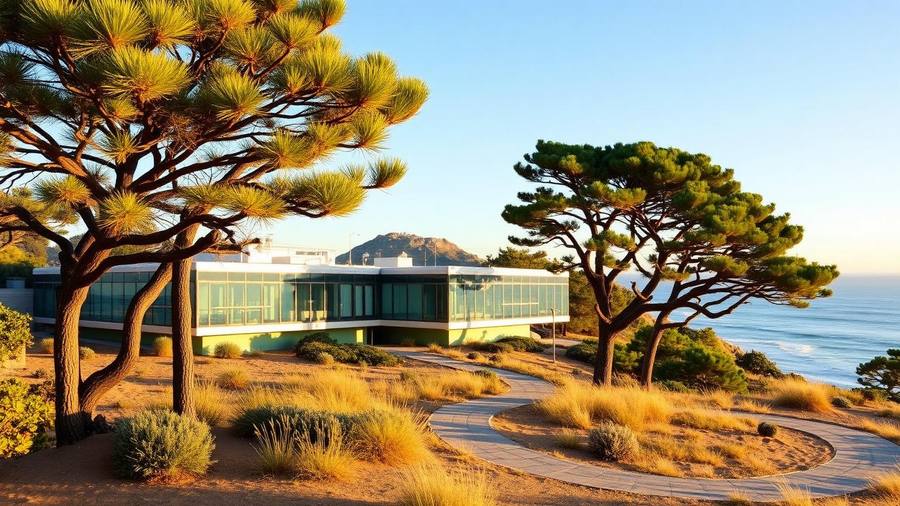
    Modern low-rise glass biotech laboratory building on the Torrey Pines coastal mesa framed by Torrey pine trees with the Pacific Ocean behind

    The Torrey Pines Biotech Corridor

    A two-mile stretch of coastal mesa with more genomics, antibody, and neuroscience research per acre than almost anywhere on earth.

    Last updated

    Quick answer

    The Torrey Pines Mesa is the coastal plateau between La Jolla and Del Mar where San Diego's life science industry is concentrated. Within roughly two square miles sit UC San Diego, the Salk Institute, Scripps Research, Sanford Burnham Prebys, the Scripps Institution of Oceanography, and dozens of biotech and pharmaceutical companies, with the overflow filling Sorrento Valley just inland. The cluster exists because of a deliberate chain of decisions in the late 1950s and 1960s: the city set aside mesa land for research, Jonas Salk chose the site for his institute, and UC San Diego was founded next door with a research-first faculty. Everything since — Hybritech's founding and 1980s acquisition, the spinout wave it funded, and the genomics industry that followed — grew from that seed. Torrey Pines Road and North Torrey Pines Road are the spine, and the corridor is very much a car-commute environment, with Carmel Valley, Del Mar, and La Jolla as the nearby housing.

    Torrey Pines corridor landmarks

    InstitutionFocusFoundedPublic access
    Salk InstituteNeuroscience, genetics, plant biology1960Architecture tours, ticketed
    UC San DiegoResearch university, health system1960Open campus, free parking limited
    Scripps ResearchChemistry, immunology, drug discovery1924 (as Metabolic Clinic)Limited, events only
    Sanford Burnham PrebysCancer, neuroscience, metabolism1976Limited, events only
    Scripps Institution of OceanographyOcean and climate science1903Birch Aquarium, ticketed
    Torrey Pines State ReserveCoastal reserve, trails1899 (protected)Open daily, paid parking

    How the cluster happened

    Torrey Pines was not planned as a biotech park. It became one through a sequence of decisions that each made the next one easier.

    The city gave away the land

    In the late 1950s and early 1960s San Diego voters and city leaders set aside large tracts of mesa pueblo land for research and higher education rather than housing. That land grant is the physical foundation of everything that followed.

    Salk chose the site

    Jonas Salk, already famous for the polio vaccine, selected the Torrey Pines bluff for his new institute and commissioned Louis Kahn to design it. The building opened in the mid-1960s and gave the mesa instant scientific prestige.

    UC San Diego was built next door

    Founded in 1960 with a research-first, graduate-heavy model, UCSD recruited senior faculty aggressively and became the pipeline that supplied talent to everything around it.

    Hybritech proved it could pay

    Founded in the late 1970s out of UCSD monoclonal antibody research and acquired by Eli Lilly in 1986, Hybritech created San Diego's first generation of biotech wealth. Its alumni went on to found dozens of local companies — the single most important spinout event in the region's history.

    Genomics arrived

    Sequencing and genomics tools companies took root in the 1990s and 2000s and turned San Diego into a global center for reading DNA, not just making drugs. That created demand for software and data engineers inside life science companies.

    Sorrento Valley absorbed the growth

    The mesa filled up. Lab space spilled inland into Sorrento Valley and later Sorrento Mesa and Torrey Pines Science Park, which is why the corridor is now really a two-part cluster split by the I-5.

    Working in the corridor

    The day-to-day realities of a Torrey Pines job, which are different from a downtown software job in almost every way.

    The commute defines your life

    I-5 north and Genesee Avenue back up hard in both peaks. People either live within a fifteen-minute radius or accept a long drive. There is no meaningful transit shortcut for most of the corridor.

    Where people live

    Carmel Valley and Del Mar for families, La Jolla and UTC for shorter commutes at a premium, Mira Mesa and Clairemont for value. Encinitas and Solana Beach work if you can flex your hours.

    It is quiet after 6pm

    The corridor is business parks and campuses, not a neighborhood. Post-work life happens in La Jolla, UTC, Del Mar, or downtown, which is a real adjustment if you came from a city with an office district that stays awake.

    Lunch is a car trip

    Options on the mesa itself are thin — campus food, a handful of business-park cafes, and the UTC mall a few minutes away. Most people bring lunch or drive.

    The upside nobody mentions

    You can run the Torrey Pines reserve trails or watch the sunset over Black's Beach after work. The corridor's location on a coastal bluff is genuinely one of the best perks in American science.

    Career mobility is unusually high

    Because so many employers sit within a few miles, changing jobs often means changing parking lots rather than moving house. That geographic density is the corridor's biggest career advantage.

    Visiting the mesa

    You do not need a badge to see the best of it. Several of the corridor's landmarks are open to the public.

    Salk Institute architecture tour

    Louis Kahn's travertine courtyard framing the Pacific is one of the most photographed pieces of modern architecture in the world. Guided tours run on a schedule and should be booked ahead.

    Birch Aquarium

    Scripps Institution of Oceanography's public aquarium sits on the bluff with a tide pool plaza and an ocean view that beats the exhibits on a clear day. The best family stop in the corridor.

    Torrey Pines State Natural Reserve

    Rare Torrey pines, sandstone canyons, and cliff-top trails down to the beach. Parking fills by mid-morning on weekends — go early or park at the bottom and walk up.

    UC San Diego campus

    Worth a wander for the Stuart Collection outdoor art, including the Geisel Library and the house perched on its roof. Parking is paid and enforced aggressively; the trolley Blue Line reaches campus directly.

    Black's Beach and the gliderport

    Torrey Pines Gliderport launches paragliders off the bluff all afternoon when conditions allow, and the view down the coast from the cliff edge is free.

    Torrey Pines Golf Course

    The municipal course on the same bluff, host of a PGA Tour event and a US Open. City residents get a resident rate; visitors book through the advance system.

    How to use this guide

    • • Headcounts, rents, and membership prices move constantly. Treat every number here as a recent snapshot and confirm with the company or the space before you sign anything.
    • • San Diego tech is clustered by geography more than most cities. Where you live decides your commute in a way it does not in a transit-dense metro — check the corridor before you sign a lease.
    • • Meetup schedules shift, and groups go dormant. Check the organizer's page for a confirmed date before driving across the county.
    • • The US has no digital nomad visa. Anyone working remotely from San Diego on a foreign passport should get immigration advice specific to their situation rather than relying on forum posts.

    Frequently asked

    What is the Torrey Pines biotech corridor?

    It is the concentration of life science research institutes and companies on the Torrey Pines Mesa between La Jolla and Del Mar, plus the adjacent Sorrento Valley business parks. Within a couple of square miles it holds UC San Diego, the Salk Institute, Scripps Research, Sanford Burnham Prebys, and dozens of biotech firms.

    Why is San Diego a biotech hub?

    Three things stacked up: the city set aside mesa land for research in the early 1960s, UC San Diego and the Salk Institute were founded there with research-first missions, and the 1986 acquisition of Hybritech created a wave of founders and capital that seeded the local industry. Genomics companies later built on that base.

    What companies are in Torrey Pines?

    The mesa hosts research institutes including Salk, Scripps Research, and Sanford Burnham Prebys alongside genomics, antibody, oncology, and pharmaceutical companies, with more in the adjacent Sorrento Valley business parks. The mix changes constantly as companies are acquired or wound down.

    Can you visit the Salk Institute?

    Yes. The Salk Institute runs guided architecture tours of Louis Kahn's building and its famous travertine courtyard. Tours are ticketed and run on a limited schedule, so book in advance rather than turning up.

    Where do people who work in Torrey Pines live?

    Carmel Valley, Del Mar, La Jolla, and UTC for the shortest commutes, with Mira Mesa, Clairemont, Solana Beach, and Encinitas as common value or coastal alternatives. I-5 and Genesee Avenue congestion makes living far from the mesa painful.

    Is Torrey Pines the same as Sorrento Valley?

    No, though they function as one cluster. Torrey Pines is the coastal mesa with the research institutes and premium lab space; Sorrento Valley is the inland business-park area just east across I-5 where much of the industry's growth and its more affordable lab space sits.

    Keep reading

    The Sandi Spots Newsletter

    San Diego, in your inbox.

    New beach finds, hidden taco shops, weekend events, and seasonal guides — once a week from a local. No spam, ever.

    One email a week. Unsubscribe anytime.

    About this guide

    Written and fact-checked by the Sandi Spots Editorial team — San Diego residents publishing under Sleep Coast LLC. Every place we recommend has been visited in person or verified against an official source, and no business can pay for inclusion or a higher ranking. Last updated .

    Local, first-hand. Reported on the ground in San Diego County.
    Kept current. Prices, hours, and closures reviewed on a rolling basis.
    Independent. Affiliate links never influence rankings.

    Editorial policy · About us · Suggest a correction