Sandi Spots
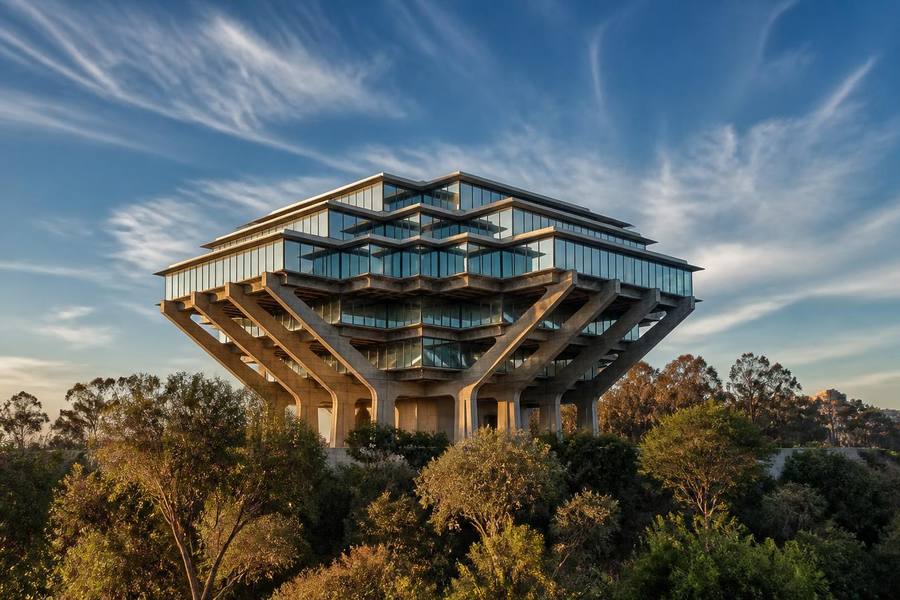
    The Brutalist concrete and glass Geisel Library at UC San Diego rising above eucalyptus trees under a bright blue sky

    San Diego Architecture: A Local's Guide to the City's Most Important Buildings

    Spanish Colonial fantasy, Brutalist concrete, modernist courtyards, and the architects who made San Diego look like no other city.

    Last updated

    Quick answer

    San Diego's architecture is best understood as a series of layers. The Spanish Colonial Revival fantasy of Balboa Park was built for the 1915 Panama-California Exposition and became the city's visual signature. Irving Gill pioneered stripped-down modernism in La Jolla and Bankers Hill in the early 1900s. Louis Kahn's Salk Institute in La Jolla is considered one of the masterpieces of 20th-century architecture. Geisel Library at UC San Diego is the city's most photographed Brutalist building. Downtown mixes historic landmarks like the Santa Fe Depot and Hotel del Coronado with a late-20th-century skyscraper boom and a more recent wave of towers, libraries and ballparks. The best way to see it is to drive or walk three corridors: Balboa Park, the La Jolla / UCSD coast, and downtown's waterfront.

    San Diego architecture by style and where to see it

    StyleWhere to see itKey buildings
    Spanish Colonial RevivalBalboa Park, Mission Hills, Old TownCalifornia Tower, Museum of Man, Junipero Serra Museum
    Early modernism / Irving GillLa Jolla, Bankers Hill, CoronadoWatford House, Dodge House, Gill's service station
    BrutalismUC San Diego, Scripps InstitutionGeisel Library, Galbraith Hall
    High modernismLa JollaSalk Institute, Louis Kahn
    Victorian / resortCoronado, Gaslamp QuarterHotel del Coronado, Victorian-era commercial blocks
    ContemporaryDowntown, East Village, Little ItalyCentral Library, One America Plaza, Petco Park

    The essential buildings

    Geisel Library

    UC San Diego, La Jolla · William Pereira, 1970

    The most photographed building in San Diego and one of the West Coast's great Brutalist statements. The library appears to float on concrete fingers, with glass boxes stacked above a canyon of eucalyptus. It was renamed for Audrey and Theodor Geisel in 1995 and now holds the Dr. Seuss Collection.

    Local tip: Park in the Hopkins or Gilman structures and walk up Library Walk. The building faces west, so late afternoon light is best.

    Salk Institute for Biological Studies

    La Jolla · Louis Kahn, 1965

    Widely considered one of the most important buildings of the 20th century. Two symmetrical wings of teak and concrete frame a travertine courtyard that draws the eye straight to the Pacific. It was commissioned by Jonas Salk, developer of the polio vaccine.

    Local tip: Public tours are limited and must be reserved in advance; the courtyard view from the public entry is worth the effort.

    Balboa Park's El Prado

    Balboa Park · Bertram Goodhue, 1915

    The ornate Spanish Colonial Revival buildings along El Prado were originally built as temporary exposition halls for the 1915 Panama-California Exposition. The fantasy proved so popular that the city rebuilt many of them in permanent materials.

    Local tip: Start at the Cabrillo Bridge and walk east through the California Tower and the Museum of Man. The Botanical Building lily pond is the classic foreground.

    Hotel del Coronado

    Coronado · James Reid, 1888

    One of the last surviving great Victorian beach resorts in the United States, with a red-tiled turret roof that dominates the Coronado beachfront. It was the largest resort hotel in the world when it opened.

    Local tip: Walk through the lobby even if you're not staying — the woodwork and beach views are public-accessible.

    California Tower and Museum of Man

    Balboa Park · 1915, rebuilt 1935

    The tower is the exclamation point of Balboa Park's skyline. The building's Spanish Baroque details, tile dome and carved figures were designed to look centuries older than they are.

    Local tip: Tower tours are ticketed and sell out; book ahead if you want the view from the belfry.

    San Diego Central Library

    Downtown, East Village · Rob Quigley, 2013

    A nine-story steel-and-glass dome that changed downtown's architectural identity. The library includes a public roof garden, an auditorium, and a charter high school.

    Local tip: Take the elevator to the top-floor reading room and roof garden for a free view of the bay and Coronado Bridge.

    Santa Fe Depot

    Downtown · 1915

    Still an active Amtrak and commuter rail station, the depot is a Spanish Colonial Revival landmark with a grand waiting room, tile work and a 20-foot stained-glass window. It anchors the downtown waterfront edge.

    Local tip: The waiting room is open to the public and one of the least visited beautiful interiors downtown.

    One America Plaza

    Downtown · Helmut Jahn, 1991

    San Diego's tallest building for decades, a sharply pointed postmodern tower that references the white passenger liners once common on the bay. It remains a defining element of the skyline.

    Local tip: Best viewed from Coronado, the ferry landing, or Harbor Island at sunset.
    Architects who shaped the city

    Irving Gill

    La Jolla, Bankers Hill, Coronado · 1870–1936

    The most important San Diego architect you've never heard of. Gill stripped away Victorian ornament before modernism had a name, using flat roofs, arched openings, concrete and white stucco. His Watford House, Dodge House and former La Jolla service station still stand.

    Louis Kahn

    La Jolla · Salk Institute, 1965

    The Philadelphia architect left only a handful of buildings on the West Coast; the Salk Institute is the most significant. Its travertine courtyard, teak windows and precise light make it a pilgrimage site for architects.

    William Pereira

    UC San Diego, La Jolla · Geisel Library, 1970

    The Los Angeles architect gave San Diego its most dramatic Brutalist landmark. Pereira also worked on the broader UC San Diego campus plan, which helped define the university's canyon-and-concrete identity.

    Bertram Goodhue

    Balboa Park · 1915 Exposition

    Goodhue designed the core buildings of the Panama-California Exposition, importing Spanish Baroque, Plateresque and Churrigueresque details to create the fantasy city that became Balboa Park's permanent identity.

    Neighborhoods for architecture walks

    Balboa Park

    Central

    The densest concentration of Spanish Colonial Revival in the country, plus the Botanical Building, the Old Globe, the Mingei Museum and the Museum of Photographic Arts in later buildings. Plan for a full morning.

    La Jolla

    Coastal

    Gill houses in the village, the Salk Institute to the north, Geisel Library at UCSD, and the contemporary Scripps Institution buildings along the bluffs. A coastal architecture day trip.

    Bankers Hill

    Downtown-adjacent

    A preserved mix of early-20th-century houses, including several Irving Gill designs, set on a hill with views toward the bay. Walk along First and Second Avenues.

    Gaslamp Quarter

    Downtown

    Victorian-era commercial blocks restored in the 1980s and 1990s. The architecture is smaller-scale than the modern towers around it and best seen on foot.

    Coronado

    Island

    The Hotel del Coronado is the headline, but the island has a full range of late-19th- and early-20th-century residential styles, from Victorian cottages to Craftsman bungalows.

    Old Town and Presidio

    Old Town

    Adobe ruins, reconstructed mission-era buildings and the Junipero Serra Museum on Presidio Hill, designed by William Templeton Johnson in Spanish Revival style.

    Visiting tips

    • • Many buildings on this list are public or have public interiors, but the Salk Institute and California Tower require advance reservations.
    • • UC San Diego is a large, hilly campus. Use the campus parking structures and allow extra time to walk to Geisel Library.
    • • The best light for photography is late afternoon, when the low sun hits Balboa Park's tile and Geisel Library's concrete from the west.

    Frequently asked

    What is the most famous building in San Diego?

    The Hotel del Coronado is the most widely recognized historic building, while Geisel Library at UC San Diego is the most photographed and architecturally distinctive modern building.

    What architectural style is Balboa Park?

    Spanish Colonial Revival, with heavy Spanish Baroque, Plateresque and Churrigueresque ornament. The buildings were designed by Bertram Goodhue for the 1915 Panama-California Exposition.

    Can you tour the Salk Institute?

    Yes, but public tours are limited and must be reserved in advance through the Salk Institute website. The courtyard view is the architectural highlight.

    Who was Irving Gill?

    An early modernist architect who worked in San Diego and Southern California from the 1890s through the 1930s. He stripped away Victorian ornament and used white stucco, flat roofs and arched openings decades before modernism became mainstream.

    What is the best free architecture to see in San Diego?

    Balboa Park's El Prado, Geisel Library's exterior, the Central Library's public roof garden, the Santa Fe Depot waiting room, and the Hotel del Coronado lobby are all free or mostly free to experience.

    Where can I see mid-century modern architecture in San Diego?

    Point Loma and La Jolla have strong concentrations of postwar modernist houses. The Salk Institute is the high point of the era, and the San Diego Central Library represents a more recent contemporary take.

    Keep reading

    The Sandi Spots Newsletter

    San Diego, in your inbox.

    New beach finds, hidden taco shops, weekend events, and seasonal guides — once a week from a local. No spam, ever.

    One email a week. Unsubscribe anytime.

    About this guide

    Written and fact-checked by the Sandi Spots Editorial team — San Diego residents publishing under Sleep Coast LLC. Every place we recommend has been visited in person or verified against an official source, and no business can pay for inclusion or a higher ranking. Last updated .

    Local, first-hand. Reported on the ground in San Diego County.
    Kept current. Prices, hours, and closures reviewed on a rolling basis.
    Independent. Affiliate links never influence rankings.

    Editorial policy · About us · Suggest a correction