Sandi Spots
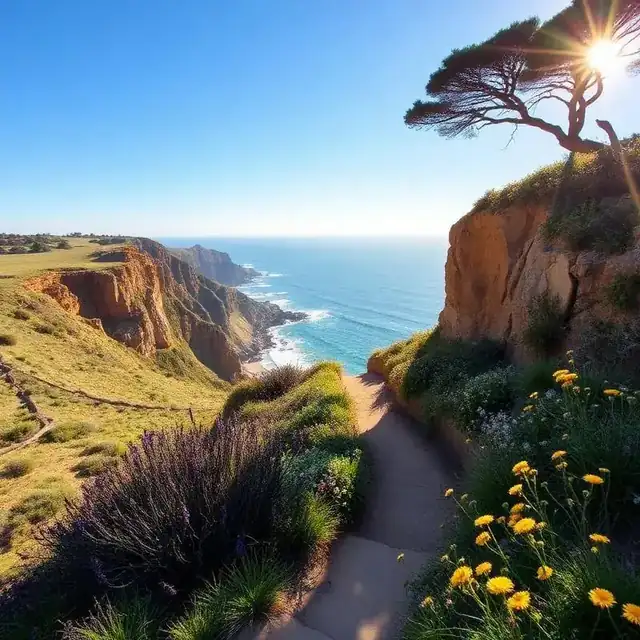
    Sandstone bluffs and rare Torrey pine trees above the Pacific Ocean at Torrey Pines State Natural Reserve

    Torrey Pines State Natural Reserve

    Current reserve closures, beach access and trails to consider after reopening.

    Last updated

    Quick answer

    Torrey Pines State Natural Reserve is closed to vehicles and pedestrians through February 2027 for construction. This includes the park road, all reserve trails, the Lodge, the upper lots and the Beach Trail staircase. California State Parks expects full access by March 1, 2027. Torrey Pines State Beach and its North Beach and South Beach lots remain open. Check current park alerts, tides and surf, and stay well clear of the bluffs.

    Reserve trails after reopening

    TrailDistanceWhat you get
    Guy Fleming Trail0.7 mi loop, easyTwo ocean overlooks, most accessible
    Razor Point Trail1.3 mi round trip, easy-moderateEroded badlands and cliff views
    Yucca Point1.5 mi round trip, moderateDramatic bluff-edge overlook
    Beach Trail0.75 mi each way, moderateDescends to the sand, steep return
    Broken Hill Trail2.4 mi loop, moderateLongest option, fewest people
    Parry Grove Trail0.5 mi loop, steep stairsRare pines up close

    Notes from the ground

    Written by San Diego residents from our own time in these places — not collected from press releases.

    Torrey Pines State Natural Reserve

    · Local knowledge, kept current

    Parking, from experience
    The upper lot by the lodge is small and fills early on weekends. The lower lot by the beach entrance is bigger, but then the trails start with a climb — decide which end of the hill you want to do tired.
    Getting in
    There is no food, no shade to speak of, and the trails are sandstone that gets hot fast. Carry water even for the short loops.
    When to go
    Check the tide before planning to walk back along the beach from Flat Rock — at a high tide that return route is not a walk you want to be committed to.

    How the reserve came to be

    The rarest pine in America

    The Torrey pine grows naturally only here and on Santa Rosa Island off Santa Barbara. Botanist Charles Parry named it in 1850 for his mentor John Torrey after encountering the trees while surveying the U.S.–Mexico boundary after the Mexican-American War.

    Ellen Browning Scripps steps in

    By the 1890s the surviving groves were being cut for firewood and trampled by grazing livestock. Newspaperman E.W. Scripps and his sister Ellen Browning Scripps began buying the land, and in 1899 the city set aside 369 acres as a public park — the beginning of the reserve.

    Guy Fleming, the park's guardian

    Naturalist Guy Fleming became the park's custodian in the 1920s, guiding visitors and campaigning against development for decades. The easiest trail in the reserve, with its two ocean overlooks, is named for him.

    Becoming a State Reserve

    The city park lands were transferred to the state park system in the 1950s, and the area was designated a State Natural Reserve in 1959 — the strictest protection category in the state system, which is why the rules here are so much tighter than a typical park.

    The pueblo lands beneath it

    The bluffs and canyons were part of San Diego's original Spanish-era pueblo lands, and before that, Kumeyaay territory. Shell middens found in the reserve trace thousands of years of coastal settlement.

    Parking and getting in

    South Beach lot

    At sea level by the entrance kiosk, the largest lot, and the one that fills first on weekends. Day-use fee varies by day and season, roughly $15 to $25.

    The upper lot

    The upper lots and park road are closed during construction. Use a beach entrance for the coast.

    Free street parking

    Follow posted parking signs and use public sidewalks. Street parking does not give access to the closed park road or trails.

    Choose beach hours and tide conditions

    The beach lots can fill on busy days. Check park hours and surf, and choose a daylight window with room to stay well clear of the bluffs.

    Annual state park pass

    If you'll come more than five or six times a year, the California State Parks annual pass pays for itself and works at other coastal reserves too.

    Trail options after reopening and current beach access

    Guy Fleming Trail

    The easiest walk in the reserve and the best one if you have limited time or mobility — a flat two-thirds-mile loop with north and south overlooks.

    Razor Point and Yucca Point

    The photogenic pair. Razor Point looks out over eroded sandstone gullies that look like a miniature badlands; Yucca Point sits right on the bluff edge over the ocean.

    Beach Trail down to Flat Rock

    The Beach Trail and its staircase are closed during construction. Use North Beach or South Beach access for the shore.

    Broken Hill Trail

    Two-plus miles through the inland chaparral with far fewer people. Take it if the main trails look like a queue.

    Walking the beach

    Choose a short walk from an open beach entrance. Give the bluff base a wide berth, and turn back when surf or rising water leaves too little clear sand.

    Parking, entry fees and the free workaround

    Torrey Pines charges by lot and by day, and the difference between paying $25 and paying nothing is where you leave the car.

    Upper (top of the hill) lot

    Closest to the visitor center and every trailhead, and the first to fill. Day-use fees run roughly $15-$25 depending on day and season, paid at the kiosk on the way in.

    Local tip: Arrive before 8:30am on weekends or expect a wait line on North Torrey Pines Road.

    Lower (beach) lot

    Same fee structure, right at Torrey Pines State Beach. From here it's a paved 0.75-mile climb up the park road to the trailheads.

    Local tip: The walk up is the warm-up — most people underestimate it in midday heat.

    Free street parking on North Torrey Pines Road

    The shoulder along the highway south of the entrance is free and legal where marked, adding a 10-20 minute walk to the lower entrance.

    Local tip: This is what locals do. Get there early; the shoulder fills by 9am on Saturdays.

    Annual pass math

    A California State Parks annual day-use pass pays for itself in about five visits and also covers other coastal state beaches nearby.

    Local tip: Worth it if you're local and hike here monthly.

    Which trail to hike, by time and ability

    The reserve is small — under 2,000 acres — but the trails vary from a flat overlook stroll to a steep sandstone descent to the beach.

    Guy Fleming Trail (0.7 mi loop, easy)

    Flat loop with two ocean overlooks and the best wildflowers in spring. Doable in 25 minutes and the only route that works for most mobility levels.

    Local tip: Best whale-watching viewpoint in the park from December through March.

    Razor Point Trail (1.3 mi, easy-moderate)

    Follows the badlands ridge past eroded sandstone spires to a dramatic cliff overlook. No shade at all.

    Local tip: Go at golden hour — the sandstone lights up orange and the crowds have gone.

    Beach Trail (1.5 mi round trip, moderate)

    The classic: descends through the pines and drops onto the beach via a staircase near Flat Rock. Steep on the return climb.

    Local tip: Check the tide chart — the return along the sand is only comfortable on a low or falling tide.

    Broken Hill Trail (2.4 mi, moderate)

    The longest route, splitting into north and south forks through chaparral before joining the Beach Trail. Fewest people in the park.

    Local tip: Pair the south fork down and the north fork back for a full loop without repeating scenery.

    Rules people get cited for

    Torrey Pines is a natural reserve, not a regular state park, and the rules are stricter than the beach a hundred yards away.

    No dogs anywhere

    Dogs are banned on all reserve trails and on the beach inside reserve boundaries, service animals excepted. Rangers do ticket.

    Local tip: Take the dog to Del Mar's North Beach or Ocean Beach instead.

    No food on the trails

    Eating is restricted to the beach and designated picnic areas to keep wildlife from habituating. Water is fine everywhere.

    Local tip: Eat at the lower lot before or after your hike.

    Stay on trail

    The sandstone is fragile and the bluff edges collapse without warning. Cliff failures happen here every year.

    Local tip: Never stand on an undercut bluff edge for a photo, and don't sit at the base of the cliffs on the beach.

    Hours and gate closure

    The reserve opens at 7:15am and gates close at sunset; cars left inside get locked in overnight.

    Local tip: Leave the parking lot 20 minutes before posted sunset.

    Rules people get fined for

    • • No dogs, anywhere in the reserve, including the beach and inside vehicles in the lot — this is the most-cited rule and rangers do enforce it.
    • • No food or picnicking anywhere in the reserve; eat before you go or at the beach outside the boundary.
    • • Stay on marked trails. Cutting across the sandstone destroys the formations and is the fastest way to get a citation.
    • • No drones, no smoking, and no collecting plants, rocks or anything else.
    • • Hours, fees and trail closures change; confirm with California State Parks before you drive out.

    Frequently asked

    How much is parking at Torrey Pines State Natural Reserve?

    The open North Beach lot generally costs $10 to $25 per vehicle, and South Beach costs $15 to $25. Rates vary. The upper lots are closed during construction.

    Are dogs allowed at Torrey Pines State Natural Reserve?

    No. Dogs are prohibited everywhere in the reserve, including the trails, the beach within the boundary and inside parked vehicles. It's the most commonly enforced rule there.

    What's the best trail at Torrey Pines?

    The reserve trails are closed through February 2027. When they reopen, Guy Fleming is a short loop with ocean overlooks. Verify trail status before visiting.

    When should you go to Torrey Pines?

    For the open state beach, choose daylight and leave enough room between surf and cliffs. Confirm hours and alerts with State Parks.

    Can you bring food to Torrey Pines?

    No. Food and picnicking are prohibited throughout the reserve, including the beach inside its boundary. Water is fine.

    How long does it take to hike Torrey Pines?

    Reserve hiking is unavailable during construction. After the park reopens, check the posted trail distances to choose a route for your time and ability.

    How much does it cost to park at Torrey Pines State Natural Reserve?

    Day-use parking runs roughly $15-$25 per vehicle depending on the day and season, paid at the entry kiosk for either the upper or lower lot. Free street parking is available along the shoulder of North Torrey Pines Road, about a 10-20 minute walk from the lower entrance.

    Are dogs allowed at Torrey Pines?

    No. Dogs are prohibited on every trail and on the beach within the reserve boundary, and rangers actively enforce it. The nearest dog-legal sand is Del Mar's North Beach (off-leash mid-September to mid-June) and Ocean Beach Dog Beach.

    What is the best trail at Torrey Pines?

    The Beach Trail (1.5 miles round trip) is the classic — it descends through the pine grove and drops onto the sand near Flat Rock. For an easy walk, do the flat 0.7-mile Guy Fleming loop; for the best cliff views, take Razor Point at golden hour.

    What time does Torrey Pines State Natural Reserve open?

    The reserve opens at 7:15am and the gates close at sunset. Cars left in the lot after closing get locked in overnight, so plan to leave about 20 minutes before posted sunset.

    Can you eat at Torrey Pines?

    Not on the trails. Food is restricted to the beach and designated picnic areas to keep wildlife from getting habituated. Water is allowed everywhere in the reserve.

    Keep reading

    Everything about Torrey Pines in one place

    Tickets, parking, food and hotels nearby, comparisons and every guide we publish about Torrey Pines State Natural Reserve.

    The Sandi Spots Newsletter

    San Diego, in your inbox.

    New beach finds, hidden taco shops, weekend events, and seasonal guides — once a week from a local. No spam, ever.

    One email a week. Unsubscribe anytime.

    About this guide

    Published by the Sandi Spots Editorial team at Sleep Coast LLC. Guides combine local perspective and source research. Check the individual guide for firsthand observations and follow official links to confirm current details.

    San Diego focused. Places and practical planning across the county.
    Kept current. Confirm prices, hours, and closures with the venue.
    Independent. Affiliate links never influence rankings.

    Editorial policy · About us · Suggest a correction