Sandi Spots
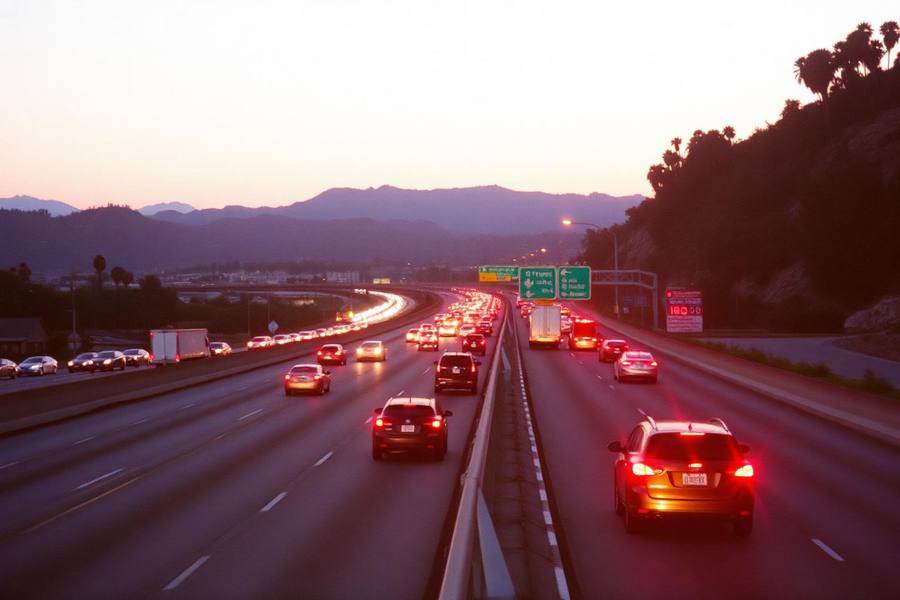
    San Diego freeway traffic at dusk seen from an overpass with brake lights and hills in the distance

    San Diego Commute Times & Traffic

    Which corridors seize up, when, and how to choose a home you can actually leave in the morning.

    Last updated

    Quick answer

    San Diego traffic is directional and predictable rather than uniformly bad. The worst recurring bottlenecks are I-5 north through the Sorrento Valley grade in the morning and southbound in the evening, I-15 through Mira Mesa and Rancho Bernardo, I-805 at the merge and through the central corridor, SR-163 through Balboa Park, and SR-52 and SR-78 as the east-west connectors that were built for far less traffic than they carry. Morning peak runs roughly 6:30 to 9:30am and evening peak from about 3:30 to 6:30pm, worst on Thursdays and Fridays. The single most useful rule for newcomers: distance means very little here and direction means everything, because the job centers — downtown, Sorrento Valley, UTC, Kearny Mesa — pull traffic into specific corridors. Drive your prospective commute at the actual hour before you sign a lease.

    The corridors that hurt

    CorridorWhen it's badWhy
    I-5 through Sorrento ValleyAM northbound, PM southboundBiotech and tech job density plus a constrained grade
    I-15 Mira Mesa to Rancho BernardoAM southbound, PM northboundNorth inland housing feeding central job centers
    I-805 centralBoth peaksCarries the through traffic that I-5 can't absorb
    SR-163 at Balboa ParkBoth peaksOlder, narrower design funneling into downtown
    SR-52Both peaksThe main east-west link, chronically undersized
    SR-78 Oceanside to EscondidoBoth peaksThe only real east-west route in North County
    I-5 south to the borderAfternoons and weekendsBorder crossing queues back up onto the freeway

    How San Diego traffic actually behaves

    It's directional, not citywide

    Commuting against the dominant flow is often genuinely easy. Living in North Park and working in Mira Mesa is a different experience from living in Mira Mesa and working downtown, even though the map distance is the same.

    The job centers define the pain

    Downtown, Sorrento Valley and Torrey Pines, UTC and La Jolla, Kearny Mesa, and Carlsbad are the big employment nodes. Traffic patterns are essentially the sum of housing feeding into those five areas.

    Thursday and Friday are the worst days

    Hybrid work has shifted the peak. Tuesdays through Thursdays are the heaviest in-office days, and Friday afternoons add early weekend and beach traffic on top.

    Beach traffic is a real weekend factor

    Summer weekends and any hot day push traffic toward the coast — I-8 west to Ocean Beach and Mission Beach, and the routes into Pacific Beach and La Jolla, back up in the late morning.

    Special events matter more than you'd think

    Padres home games, Comic-Con week, concerts at the downtown venues, and Del Mar racing season each reshape traffic in their part of the county for hours.

    The marine layer doesn't slow anyone down, but rain does

    San Diego gets little rain, and when it does arrive, freeway speeds collapse and collision rates spike. The first rain after a dry spell is the worst day of the year to drive.

    Typical commute pairings

    Approximate rush-hour experiences reported by residents. Treat these as directional guidance, not a timetable — check your specific route in a maps app at the exact hour.

    North Park or Hillcrest → Downtown

    One of the easiest commutes in the city. Short, multiple route options, and reverse-flow for part of it. A major reason those neighborhoods are popular with downtown workers.

    Anywhere inland → Sorrento Valley

    The hardest common commute in the county in the morning. The I-5 and I-805 approaches both congest, and there's no good alternate. Living north of the grade or in the Mira Mesa/Carmel Valley area is the standard workaround.

    Chula Vista → Downtown

    Manageable on I-5 or I-805 outside the worst of the peak, and the Blue Line trolley makes it a genuine transit commute — one of the few in the county where transit is competitive with driving.

    Oceanside or Encinitas → Downtown

    Long by car, but the Coaster commuter rail runs the corridor and is comfortable if your schedule fits the timetable. This is the classic North County tradeoff: cheaper housing, longer but sometimes trainable commute.

    East County → Central San Diego

    El Cajon, Santee and La Mesa feed I-8 and SR-125 westbound. The Green and Orange trolley lines serve much of this corridor and are a real option for downtown-bound workers.

    Coastal North County → Carlsbad job centers

    Short and comparatively painless, which is part of why Carlsbad and Encinitas hold their premium for people who work in North County.

    Alternatives to sitting in it

    The Trolley

    Blue, Orange and Green lines connect Chula Vista, downtown, Mission Valley, UTC and East County. The Blue Line extension to UTC and UCSD changed the calculus for a lot of North City commuters — genuinely competitive with driving for that corridor.

    The Coaster and Sprinter

    The Coaster runs the coastal corridor between Oceanside and downtown; the Sprinter connects Oceanside to Escondido. Both work well if your hours align with the schedule and poorly if they don't.

    Express lanes

    I-15 and parts of the network have managed express lanes that carpools use free and solo drivers can buy into with a transponder. On the I-15 corridor they can save meaningful time at peak.

    Shift your hours

    Leaving before 6:30am or after 9:30am transforms most of these commutes. Many San Diego employers are flexible about this precisely because the traffic is so time-dependent.

    Bike and e-bike

    Flat coastal stretches and the central neighborhoods are increasingly bikeable, and e-bikes have made the hills between the mesas and the coast a non-issue for a lot of commuters.

    Before you sign a lease

    • • Drive the commute at the exact hour you would drive it, on a Tuesday through Thursday, in both directions.
    • • Check whether your route has a transit alternative you would realistically use — that's what makes a long commute survivable.
    • • Ask whether the office has flexible hours before optimizing your housing search around peak-hour traffic.
    • • Remember that in San Diego, ten miles in the wrong direction is worse than twenty in the right one.

    Frequently asked

    What is the worst traffic in San Diego?

    I-5 through the Sorrento Valley grade is the most reliably painful — northbound in the morning and southbound in the evening — because it funnels the region's biotech and tech workforce through a constrained stretch. I-15 through Mira Mesa and Rancho Bernardo, SR-52, and SR-78 in North County are the other chronic bottlenecks.

    What time is rush hour in San Diego?

    Roughly 6:30 to 9:30am and 3:30 to 6:30pm, with Tuesday through Thursday the heaviest in-office days and Friday afternoons adding early weekend and beach traffic. Leaving 30 minutes earlier or later than the peak often cuts a commute substantially.

    Do you need a car in San Diego?

    For most of the county, yes. The exceptions are downtown, East Village, Hillcrest and North Park, plus the trolley corridors through Chula Vista, Mission Valley and East County, where car-free living is workable if you plan around it.

    Is public transit good in San Diego?

    It's good on specific corridors rather than citywide. The Trolley's Blue, Orange and Green lines and the Coaster commuter rail are genuinely competitive with driving for the routes they serve, particularly Chula Vista to downtown and the UTC/UCSD corridor. Outside those spines, service is thinner.

    How long is the commute from North County to downtown San Diego?

    By car it can easily exceed an hour at peak from Oceanside or Vista. The Coaster runs the coastal corridor and is far more pleasant if your schedule matches the timetable — that combination is the standard North County tradeoff.

    How should traffic affect where I live in San Diego?

    More than almost any other factor. Because traffic here is directional, the right question isn't how far you'll live from work but which direction you'll be driving at peak. Drive the exact route at the exact hour before you commit to a lease or a purchase.

    Keep reading

    The Sandi Spots Newsletter

    San Diego, in your inbox.

    New beach finds, hidden taco shops, weekend events, and seasonal guides — once a week from a local. No spam, ever.

    One email a week. Unsubscribe anytime.

    About this guide

    Written and fact-checked by the Sandi Spots Editorial team — San Diego residents publishing under Sleep Coast LLC. Every place we recommend has been visited in person or verified against an official source, and no business can pay for inclusion or a higher ranking. Last updated .

    Local, first-hand. Reported on the ground in San Diego County.
    Kept current. Prices, hours, and closures reviewed on a rolling basis.
    Independent. Affiliate links never influence rankings.

    Editorial policy · About us · Suggest a correction