Locations, dates, and hours
Exact addresses or cross streets, load-in and wrap times, and every alternate you might use. Adding a location later usually means an amendment and another review cycle.
We use cookies for essential site functions and, with your permission, for analytics and advertising. California residents can opt out of the sale or sharing of personal information at any time. See our Privacy Policy, Cookie Policy, and Do Not Sell or Share My Personal Information.
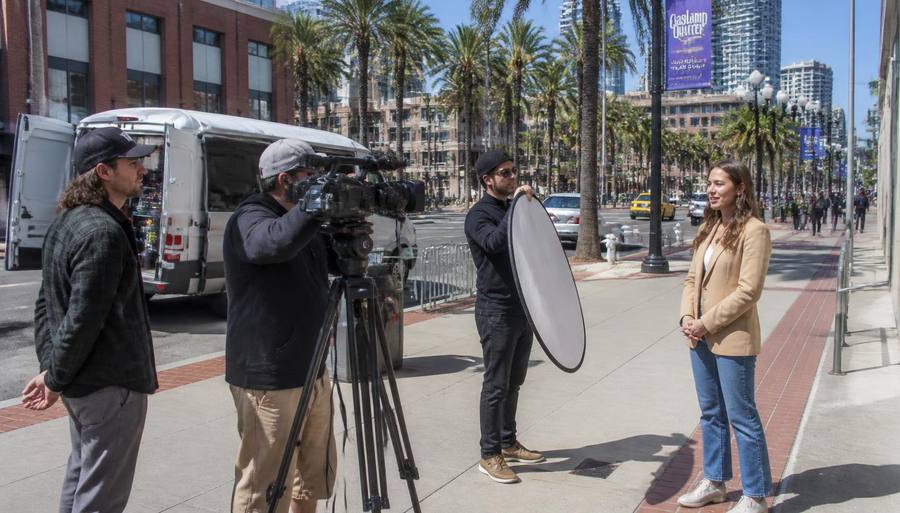
From a two-person commercial shoot to a street closure — the agencies, the paperwork, the insurance, and the timeline.
Last updated
San Diego does not have one permit office. Which agency you deal with depends entirely on who owns the location: the City of San Diego handles city streets, parks, and beaches; the County handles county parks and unincorporated roads; Caltrans handles state highways; the Port of San Diego covers the bayfront including Embarcadero, Shelter Island, Harbor Island, and Coronado's bay side; California State Parks covers Torrey Pines and the state beaches; the National Park Service covers Cabrillo; and Coronado, Del Mar, Encinitas, Carlsbad, Oceanside, Chula Vista, and the other incorporated cities each run their own desk. The regional film office is the practical starting point — it will tell you which jurisdictions your shot list touches and how to sequence the applications. Every process asks for the same core package: a completed application with dates, locations, and crew size; a shooting schedule; proof of general liability insurance naming the agency as additional insured, usually at a one to two million dollar limit; workers' compensation if you have employees; and additional riders for vehicles, drones, stunts, pyro, or firearms. Budget two weeks minimum for a simple static shoot on public property and four to six weeks for anything involving lane closures, parking meter reservations, base camp, or multiple jurisdictions in one day. Costs stack: an application fee, per-day location fees, police or lifeguard staffing when required, meter bagging per space per day, and park use fees. A modest one-day commercial on a city street usually lands in the high hundreds to low thousands once staffing and meters are added; a closure day is a different order of magnitude entirely.
| Jurisdiction | What it covers | Notes |
|---|---|---|
| City of San Diego | City streets, parks, beaches, Balboa Park | Police and lifeguard staffing billed separately when required |
| Port of San Diego | Embarcadero, Shelter & Harbor Island, bayfront tidelands | Separate application; tidelands are not city property |
| County of San Diego | County parks, unincorporated roads and open space | Covers much of East County and the backcountry |
| California State Parks | Torrey Pines, Cardiff, San Elijo, Silver Strand, Old Town SHP | Application fee plus per-day location fee |
| National Park Service | Cabrillo National Monument | Federal permit; cost recovery model; no drones |
| Caltrans | State highways and freeway right-of-way | Long lead times; CHP coordination for any lane work |
| Coronado / Del Mar / Encinitas / Carlsbad / Oceanside | Their own streets, beaches, and parks | Independent applications and fee schedules |
| Airport and transit authorities | SAN terminals, MTS trolley and bus, Amtrak platforms | Separate approvals with escorts and strict windows |
| Universities and school districts | UCSD, SDSU, USD, district campuses | Institutional location agreements, not city permits |
| Private property | Hotels, restaurants, homes, studios | Location agreement with the owner; city permit may still apply to the street outside |
Rates and availability change daily, so we link the guide rather than quote a price. Each page compares walkable, short-drive and budget options with parking and resort fees called out.
Exact addresses or cross streets, load-in and wrap times, and every alternate you might use. Adding a location later usually means an amendment and another review cycle.
Fees and staffing requirements scale off these numbers. Undercounting to save money is how a shoot gets shut down when twenty people show up on a six-person permit.
General liability, typically one to two million per occurrence, with the specific agency named as additional insured using their exact legal wording. This is the single most common cause of delay.
Required if you have employees, including day-hire crew in most configurations. Have the certificate ready with the application.
Meter bagging, no-parking postings with the required advance notice, base camp location, and any lane or sidewalk impact. Posting notice periods are strict and are counted in days, not hours.
Drones need a Part 107 pilot and often a separate approval, stunts and pyro need fire department sign-off, firearms need police notification, and minors need studio teacher and work permit compliance under California law.
Residential and business notification letters are frequently required a set number of days ahead, and community pushback is the most common reason a permit gets conditioned or denied.
One call maps your shot list to jurisdictions and tells you which applications run in parallel. It costs nothing and saves the classic mistake of permitting the beach but not the tidelands you are standing on.
A day that stays inside one agency is dramatically cheaper and faster than a day that crosses three. Rewriting the schedule around jurisdiction lines is usually the biggest single saving available.
A location agreement with a hotel, restaurant, or private plaza replaces a public permit entirely — though the street and sidewalk outside are still public.
Several jurisdictions have a reduced process for small crews with no closures, no generators, and handheld gear. If you genuinely fit, say so early.
Reduced or waived fees are common for accredited student productions and documented nonprofit work, with proof of enrollment or status.
Weather, tides, and a lost location all force changes. Ask up front what an amendment costs and how many days it takes, so a change on Wednesday does not kill a Saturday shoot.
The smaller-scale version for portrait and wedding work.
What has to be true before aerials go in the plan.
Scouting notes with light and access details.
Local gear sources for production support.
Indoor spaces that need no city permit.
Controlled environments when the permit math does not work.
Two weeks is a realistic minimum for a simple, static, no-closure shoot on public property with clean insurance in hand. Four to six weeks is the honest number once you add lane closures, meter reservations, multiple jurisdictions, drones, stunts, or neighborhood notification. Caltrans and federal sites run longest.
There is no single price. You pay an application fee, per-day location fees, and then the real variables: police or lifeguard staffing at hourly rates when the agency requires it, meter bagging charged per space per day, and park or facility use fees. A small one-day city street shoot commonly lands in the high hundreds to low thousands all in; a full closure with staffing is far more.
Usually yes on public property if it is commercial, though several jurisdictions have a simplified low-impact tier for tiny crews with handheld gear and no closures. Filming entirely on private property with the owner's written permission generally does not need a city permit — until your crew, cables, or vehicles reach the sidewalk.
General liability, commonly one to two million dollars per occurrence, with a certificate naming the issuing agency as additional insured in their exact required wording, plus workers' compensation if you have employees. Vehicles, drones, watercraft, stunts, and pyro each add their own requirements. Short-term production policies are widely available and are the fastest fix when a permit stalls.
The regional film office. San Diego's locations cross city, port, county, state, and federal boundaries constantly — the Embarcadero, Coronado, and the beaches are the usual traps — and one conversation up front tells you exactly how many applications you are filing and in what order.
Often at a reduced rate rather than free. Most jurisdictions have a student tier requiring proof of enrollment, a faculty signature, and the same insurance — schools frequently provide a blanket policy that covers enrolled student productions. Ask the film office and your department at the same time.
The Sandi Spots Newsletter
New beach finds, hidden taco shops, weekend events, and seasonal guides — once a week from a local. No spam, ever.
One email a week. Unsubscribe anytime.
Published by the Sandi Spots Editorial team at Sleep Coast LLC. Guides combine local perspective and source research. Check the individual guide for firsthand observations and follow official links to confirm current details.