Scout the day before at the same time
Sun position and shadow lines move fast this time of year, and the cliff that is glowing at 7:20 is in shade at 7:40. A dry run at the exact hour is worth more than any location list.
We use cookies for essential site functions and, with your permission, for analytics and advertising. California residents can opt out of the sale or sharing of personal information at any time. See our Privacy Policy, Cookie Policy, and Do Not Sell or Share My Personal Information.
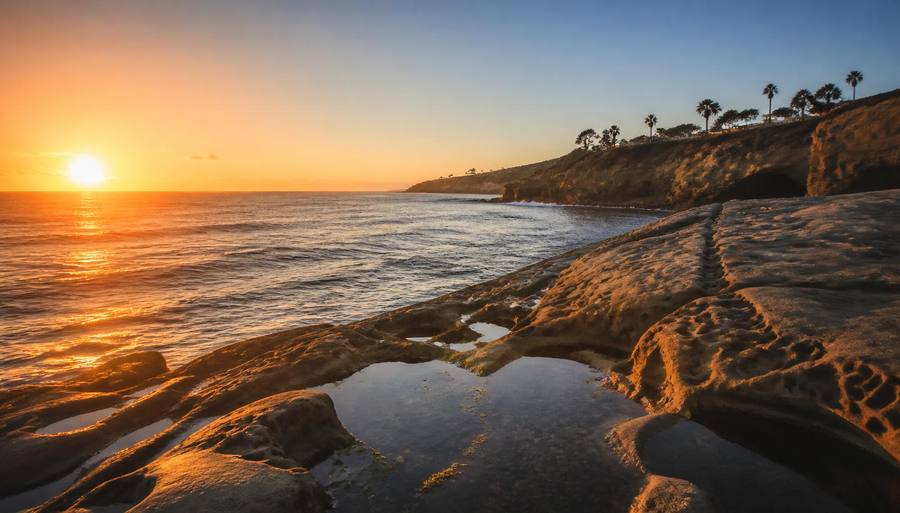
Where the light actually works, when to arrive, where to park the gear, and which locations require paperwork first.
Last updated
San Diego's coastline faces west, which means nearly every beach delivers backlit golden hour and a clean sun-into-the-ocean finish — the differences are access, crowds, tides, and paperwork. For couples work, Sunset Cliffs gives the most dramatic sandstone and sky and the most dangerous edges; Windansea offers the shack and rock formations but needs a low tide to be usable; La Jolla Cove and Scripps Park have the postcard bluff and the worst crowds; Torrey Pines State Beach gives cliffs and reflective wet sand at low tide with a long walk in; and Coronado's Central Beach gives soft open sand, the Hotel del as a backdrop, and mica that sparkles in low sun. Inland, Balboa Park's arcades and the Cabrillo Bridge take warm reflected light for the last hour, and Mount Soledad and the Coronado bayfront give you the skyline lit rather than silhouetted. Timing matters more than location: arrive ninety minutes before sunset for parking, shoot the warm window in the last forty-five minutes, and stay fifteen to twenty-five minutes past sunset for the blue-hour skyline shots people forget to plan for. Check the tide chart before committing to any rocky location — Windansea, the Torrey Pines cliff base, and the tide pools are unusable or unsafe at high tide. And remember that most of these are permit locations for commercial work: the light being free does not make the shoot free.
| Location | Best for | Access & permit notes |
|---|---|---|
| Sunset Cliffs Natural Park | Dramatic cliffs, big sky, couples | City park — commercial permit; stay off unstable edges; street parking fills early |
| Windansea Beach | Rock formations, the surf shack | City beach; needs low tide; very limited parking |
| Scripps Park & La Jolla Cove | Classic bluff and cove | City park — permit for setups; heavy crowds; protected wildlife nearby |
| Torrey Pines State Beach | Cliffs, reflective wet sand | State Parks permit; low tide only; long walk from lot |
| Coronado Central Beach | Open sand, Hotel del backdrop | City of Coronado permit process; easiest parking of the coastal spots |
| Mission Beach & the jetty | Boardwalk energy, clean horizon | City beach; summer parking is brutal after 4pm |
| Balboa Park arcades | Architecture, warm reflected light | City permit for commercial; some interiors separately controlled |
| Coronado Ferry Landing / Tidelands | Skyline lit by the setting sun | Port and city jurisdictions; great blue hour |
| Mount Soledad | Elevated 360 views, city and coast | Free, small lot, wind; respect the memorial |
| Cabrillo National Monument | Bay, skyline, tide pools | Federal permit for commercial; gate closes before sunset — check hours |
Rates and availability change daily, so we link the guide rather than quote a price. Each page compares walkable, short-drive and budget options with parking and resort fees called out.
Sun position and shadow lines move fast this time of year, and the cliff that is glowing at 7:20 is in shade at 7:40. A dry run at the exact hour is worth more than any location list.
Coastal parking is the real constraint. Ninety minutes gets you a legal space, a walk-in with gear, and time to place people before the light turns.
Windansea, Torrey Pines, the tide pools, and most rocky coves are only workable near low tide, and a rising tide can strand you against a cliff. Tides are published daily and are non-negotiable.
The fifteen to twenty-five minutes after the sun drops give you even light on faces and a deep blue sky — and it is the only window for a lit downtown skyline from Coronado.
May and June routinely bury the coast in gray while it is sunny four miles inland. When the layer is in, move the session to Balboa Park, Old Town, or an inland canyon rather than fighting it.
Applications on public land run two to four weeks. Deciding on the location a week out is how sessions end up unpermitted or relocated at the last minute.
Warm plaster and long shadows in the last hour, sheltered when the coast is fogged in, and far fewer photographers than the beaches.
Grassy hill above Pacific Beach with the bay and downtown in frame, west-facing light, and a legitimate parking situation.
Private grounds with brick, palms, and clean lines. Because it is privately managed, permission runs through the property rather than the city.
Big sky, paragliders as a background element, and a straight shot west. It is an active airfield, so stay well clear of the launch area and never fly a drone here.
Quieter La Jolla alternatives with the same water and rock, and a much better chance of not appearing in someone else's frame.
Port jurisdiction rather than city, with the bay, the ships, and the skyline all reachable in one short walk.
What each of these locations requires before a paid shoot.
Scaling up to a crew, vehicles, and closures.
Why most of these spots are not legal launch sites.
The viewing version of the same list.
Access points, safety, and parking detail.
Where to actually leave the car.
It shifts across the year — sunset runs from just before 5pm in December to just after 8pm in late June. Golden hour is roughly the final forty-five to sixty minutes before sunset, and the usable blue hour continues about twenty minutes after. Check the date's actual sunset time and work backward; do not rely on a season-old habit.
Sunset Cliffs for drama, Windansea at low tide for texture, Scripps Park for the classic La Jolla look, Coronado Central Beach for soft open sand with the Hotel del behind you, and Balboa Park when the coast is fogged in. All are permit locations for a paid photographer, so pick the location before you promise the client a date.
For personal photos, no. For a paid session, Sunset Cliffs Natural Park is City of San Diego parkland and commercial photography is a permit item — particularly with any stands, props, or a group. Apply two to four weeks out.
May and June, the local 'May Gray' and 'June Gloom,' when the coast can stay overcast until afternoon or all day while it is clear inland. The flat light is actually flattering for portraits, but if the client wants a sun-in-the-ocean shot, book an inland backup or a different month.
Windansea, the base of the Torrey Pines cliffs, the Cabrillo tide pools, and most of the rocky coves around Bird Rock and La Jolla. High tide removes the sand you would be standing on and can trap you against a cliff. Always check the day's chart before you commit a client to one of them.
The Sandi Spots Newsletter
New beach finds, hidden taco shops, weekend events, and seasonal guides — once a week from a local. No spam, ever.
One email a week. Unsubscribe anytime.
Published by the Sandi Spots Editorial team at Sleep Coast LLC. Guides combine local perspective and source research. Check the individual guide for firsthand observations and follow official links to confirm current details.