History
How the Gaslamp Quarter Went From Red-Light District to Landmark
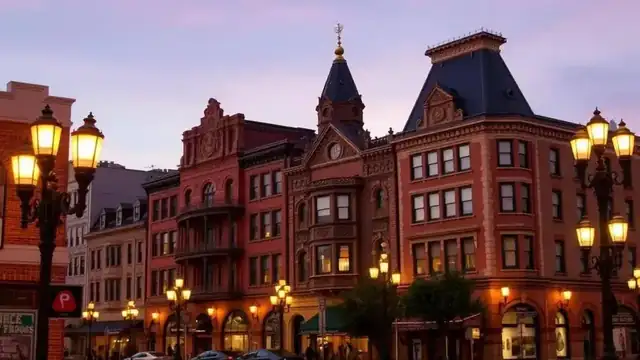
The 16-block Gaslamp Quarter is the oldest commercial district in San Diego — and twice it has nearly been demolished. Today its 94 protected Victorian and Edwardian buildings are listed on the National Register of Historic Places. A century ago, it was the seediest stretch of waterfront in California.
Alonzo Horton's $265 gamble
In 1867, Alonzo Horton, a furniture dealer from San Francisco, sailed into San Diego Bay, walked the empty land south of Old Town, and decided downtown was in the wrong place. He bought 800 acres at auction for $265 ($0.33 per acre) and laid out a grid that ignored topography in favor of small 50x100 ft lots — easier to sell. By 1870, 'Horton's Addition' had a courthouse, hotels, and a wharf. Old Town was finished.
The Stingaree
By 1880, the southern half of Horton's grid — roughly 4th to 6th and Market to the bay — had become the Stingaree, San Diego's red-light district. At its peak there were 71 saloons, 120 gambling halls, and an estimated 800 working women. Wyatt Earp, after Tombstone, ran three gambling concessions here from 1885 to 1893. His common-law wife Josephine ran a brothel two blocks away. Opium dens operated openly in the basements; many of the original tunnels still exist under the sidewalks today.
The 1912 raid
In November 1912, just before the Panama-California Exposition was set to bring tourists to Balboa Park, San Diego's police chief led a raid on the Stingaree, arresting 138 women in a single night. The brothels closed; the gambling halls became flophouses; the neighborhood emptied out. By the 1950s, downtown had moved north and the old district was mostly pawn shops, sailor bars, and tattoo parlors.
Saved by a developer in 1974
In the early 1970s the city of San Diego planned to bulldoze the entire 16-block area for a new commercial corridor. A developer named Tom Hom, along with a small group of preservationists, formed the Gaslamp Quarter Council and convinced the city to designate it a historic district instead. The first restoration — the Louis Bank of Commerce on 5th Avenue — opened in 1981. By the 1990s, the Gaslamp had become San Diego's nightlife district. Today it draws over 17 million visitors a year.
Buildings worth looking up at
Louis Bank of Commerce (1888, 837 5th Ave) — the first granite-faced building in San Diego.
Yuma Building (1888, 631 5th Ave) — the first brick building south of Market.
Keating Building (1890, 432 F Street) — designed by the architects of the Hotel del Coronado.
Old City Hall (1874, 4th & G) — the oldest commercial building in the district.
Horton Grand Hotel (1886, reassembled 1986) — moved brick by brick from a different street.
The tunnels under the sidewalks
The Gaslamp's underground is half history, half folklore. What is documented: many buildings had coal chutes, basement freight passages, and connected sub-sidewalk vaults lit by purple glass prism blocks still visible in the pavement on 5th Avenue. What is contested: the claim that a continuous tunnel network let patrons move between opium dens, brothels, and later Prohibition speakeasies. Several bars — including spaces beneath 4th and Island — do sit in original basement rooms, and a few still have bricked-over doorways to nowhere.
Chinatown and the Asian Pacific Historic District
Overlapping the southern Gaslamp is San Diego's original Chinatown, centered on 3rd Avenue between J and Market. By 1890 it held laundries, groceries, gambling halls, and a fishing fleet that supplied much of the city's seafood. The 1882 Chinese Exclusion Act and later redevelopment gutted it, but the 1927 Chinese Mission building survives as the Chinese Historical Museum, and the Asian Pacific Thematic Historic District now protects the remaining blocks.
The 1985 Horton Plaza gamble
Preservation alone did not save the Gaslamp — a shopping mall did. When Jon Jerde's technicolor Horton Plaza opened in 1985 on the district's northern edge, it dragged foot traffic back downtown for the first time in 30 years. Restaurants followed, then Petco Park in 2004, which pushed development east into the East Village. Horton Plaza itself was gutted and redeveloped as an office campus in the 2020s — a reminder that downtown San Diego rebuilds itself roughly every 40 years.
How to do a self-guided history walk
The Gaslamp Quarter Historical Foundation runs a free self-guided audio tour (download via their website) that starts at the William Heath Davis House at 4th & Island. It takes about 90 minutes. Guided tours run Saturdays at 11am for $20.
Gaslamp timeline
1867 — Alonzo Horton buys 800 acres for $265.
1880s — The Stingaree becomes the West Coast's most notorious red-light district.
1885–1893 — Wyatt Earp operates gambling halls on 4th and 6th.
1912 — Police raid arrests 138 women and effectively closes the district.
1974 — The Gaslamp Quarter Council forms to stop demolition.
1980 — Listed on the National Register of Historic Places.
1985 — Horton Plaza opens and reverses downtown's decline.
2004 — Petco Park opens and extends the district east.