Torrey Pines State Beach
Del Mar / La Jolla
Wide, flat, dark and sandy — the classic combination. Parking access at night is the main constraint.
Local tip: Scout the beach in daylight first so you know where the wide flat section is.
We use cookies for essential site functions and, with your permission, for analytics and advertising. California residents can opt out of the sale or sharing of personal information at any time. See our Privacy Policy, Cookie Policy, and Do Not Sell or Share My Personal Information.
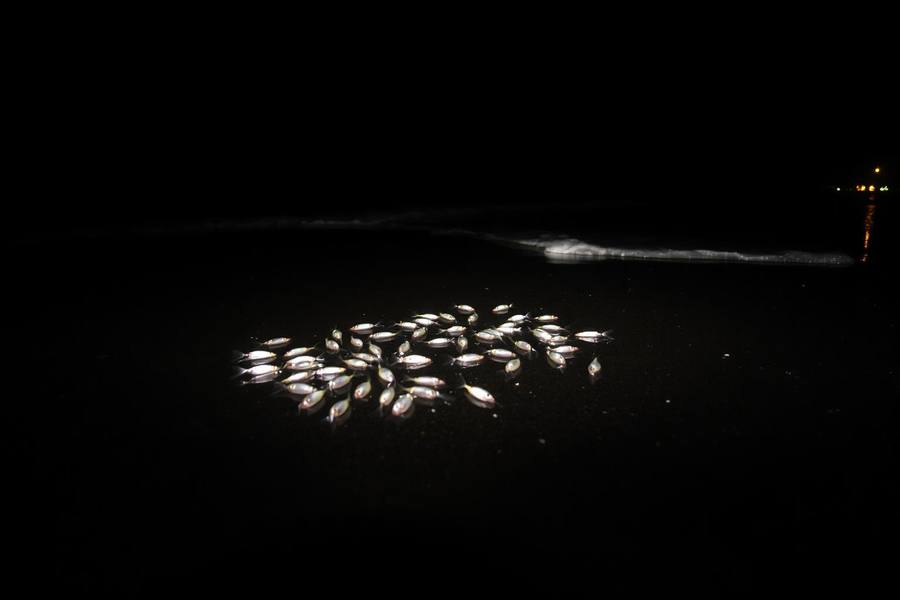
Thousands of silver fish spawning on the sand at midnight — one of the strangest things the Pacific does.
Last updated
California grunion are small silver fish that spawn on sandy beaches at night on the two to six nights following a full or new moon, during the highest tides. Runs happen from roughly March through August, and California Department of Fish and Wildlife closes the season entirely in April and May to protect spawning — during the closure you may watch but not touch. Outside the closure, anyone 16 and older needs a valid California fishing license, and the law allows catching them with bare hands only: no nets, no buckets dug into the sand, no holes. Runs typically begin an hour or two after high tide and build over about an hour. CDFW publishes predicted run schedules each season — arrive early, bring a red light, and be prepared for nothing to happen.
| Item | Detail |
|---|---|
| Season | Roughly March through August |
| Closed season | April and May — observation only, no taking |
| Timing | Nights following a full or new moon, after high tide |
| License | Required for anyone 16+ outside the closure |
| Method | Bare hands only — no nets, gear or holes in the sand |
| Duration | Runs typically build over about an hour, often after midnight |
Rates and availability change daily, so we link the guide rather than quote a price. Each page compares walkable, short-drive and budget options with parking and resort fees called out.
Grunion need wide, gently sloping sandy beaches. Rocky or steep shorelines don't work.
Del Mar / La Jolla
Wide, flat, dark and sandy — the classic combination. Parking access at night is the main constraint.
Local tip: Scout the beach in daylight first so you know where the wide flat section is.
La Jolla
One of the most reliably reported run beaches in the county, with a broad sandy slope and easy access. Also the most crowded on a predicted run night.
Mission Bay peninsula
Long uninterrupted sand and easy parking off Mission Boulevard. Ambient light from the boardwalk is the tradeoff.
Coronado
Very wide, very flat, and dark toward the south end. Excellent grunion habitat.
North County
Good sandy stretches with less crowding than La Jolla on a predicted run night.
Coronado / Imperial Beach
A long protected sandy shoreline that has historically hosted strong runs.
Local tip: State beach lots close at night; confirm access hours or park where legal outside the gate.
The California Department of Fish and Wildlife publishes expected run windows for each season by date and time. Treat them as forecasts, not guarantees — the fish don't read the calendar.
Runs usually start after high tide and build over roughly an hour. The first fish to arrive are scouts; the main run comes later.
Bright white light disrupts the run and everyone's night vision. Red light lets you see without scattering the fish.
Local tip: Sit still on the wet sand and wait. Walking the waterline with a flashlight is the surest way to see nothing.
Even on a well-predicted night, runs frequently fail to materialize at a given beach. Locals go multiple nights per season to see one good run.
It's the middle of the night on a Pacific beach. Even in July it's cold, and you'll be sitting on damp sand for an hour.
California law prohibits using any gear — nets, buckets set in the sand, traps or tools — to take grunion. Hands only, and you can't dig holes or build barriers to trap them.
Taking grunion is prohibited entirely during April and May. You may still go and watch, which is what most people should be doing anyway.
Anyone 16 or older needs a valid California sport fishing license to take grunion outside the closed season, even taking them by hand from the beach.
There's no formal bag limit in some seasons, but CDFW asks for restraint. The population depends entirely on successful beach spawning.
Eggs incubate buried in the sand for about two weeks until the next high tides release them. Driving, digging or raking the beach destroys them.
Roughly March through August, on the two to six nights following a full or new moon, beginning after the night's high tide. The California Department of Fish and Wildlife publishes predicted run windows each season.
Yes. Anyone 16 or older needs a valid California sport fishing license to take grunion outside the closed season — even catching them by hand.
California closes the take of grunion during April and May to protect the peak of the spawning season. You can still go to the beach and watch during those months; you just can't take any.
No. California law allows grunion to be taken by hand only. Nets, traps, buckets set into the sand, and digging holes or building barriers are all prohibited.
Wide, flat, sandy beaches: La Jolla Shores, Torrey Pines State Beach, Coronado, Silver Strand and the Mission Beach–Pacific Beach stretch are all regularly reported run beaches.
Usually starting an hour or two after the night's high tide and building over about an hour, which often puts the peak well after midnight. Arrive before the predicted window opens.
The Sandi Spots Newsletter
New beach finds, hidden taco shops, weekend events, and seasonal guides — once a week from a local. No spam, ever.
One email a week. Unsubscribe anytime.
Published by the Sandi Spots Editorial team at Sleep Coast LLC. Guides combine local perspective and source research. Check the individual guide for firsthand observations and follow official links to confirm current details.