History
Old Town San Diego: The Birthplace of California
On July 16, 1769, Father Junípero Serra raised a wooden cross on a hill overlooking what is now Old Town San Diego and dedicated Mission San Diego de Alcalá — the first of 21 Spanish missions in California. A few hundred yards away, the Spanish military built the Presidio. Together, these two structures made San Diego the first permanent European settlement on the entire Pacific coast of what is now the United States.
From Presidio to pueblo
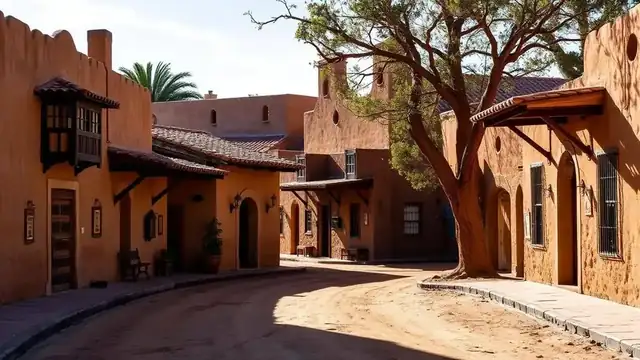
For the first 50 years, the entire population of San Diego lived inside the Presidio walls — a few dozen soldiers, priests, and their families. By the 1820s, after Mexican independence, families began moving down off the hill to flat land at the base of the Presidio. They built adobe houses around a dusty plaza. That plaza is now the heart of Old Town San Diego State Historic Park.
The flag-raising of 1846
On July 29, 1846, US Marines marched into the plaza and raised the American flag for the first time in San Diego, signaling the end of Mexican rule in California. The flagpole still stands in the plaza today, and the small ceremony is reenacted every July 29 with period costumes.
The five oldest buildings in San Diego
Casa de Estudillo (1827) — a 13-room adobe built by the commander of the Presidio. Still has its original tile roof.
Casa de Bandini (1829) — now the Cosmopolitan Hotel and restaurant. Used as a stagecoach stop.
Casa de Machado y Stewart (1830) — one of the few unaltered adobes left in California.
Casa de Pedrorena (1869) — late-period adobe with wood floors imported by clipper ship.
Whaley House (1857) — the first two-story brick building in Southern California, and one of the most allegedly haunted in America.
Why downtown moved away
In 1867, a real-estate speculator named Alonzo Horton bought 800 acres along the bay for $265 and started selling lots in what he called 'New Town' — today's downtown. By 1872, a fire destroyed much of Old Town's commercial district, and the population shifted south for good. Old Town went from being San Diego's downtown to being its forgotten frontier village within a single decade.
The Kumeyaay were here 12,000 years first
Long before 1769, the land around the San Diego River belonged to the Kumeyaay, whose villages — including Kosa'aay, near present-day Old Town — had been occupied for thousands of years. Mission records show that the Kumeyaay resisted the Spanish almost immediately: in November 1775, roughly 800 people attacked and burned Mission San Diego de Alcalá, killing Father Luis Jayme. The mission was rebuilt, but the revolt is the reason it stands six miles inland today rather than beside the Presidio. Any honest account of Old Town starts with the people who were displaced to build it.
The Mexican rancho era, 1821–1846
After Mexican independence in 1821, mission lands were secularized and carved into enormous private ranchos — Rancho Peñasquitos, Rancho Santa Fe, Rancho Jamul. Cattle hides, not gold, were San Diego's first export economy; Boston ships anchored off La Playa in Point Loma and traded manufactured goods for hides cured on the beach. Richard Henry Dana described the whole operation in Two Years Before the Mast (1840), one of the earliest published descriptions of San Diego in English.
The 1872 fire that ended Old Town
On April 20, 1872, a fire tore through the commercial buildings on the north side of the plaza. Alonzo Horton's New Town already had the wharf, the courthouse records, and the money; after the fire, few owners rebuilt. Old Town's population collapsed within a decade, and the district survived largely because nobody bothered to redevelop it — an accident of neglect that preserved the adobes long enough for the state to buy them in 1968.
Visiting Old Town today
Old Town San Diego State Historic Park is free to enter, open daily, and includes 12 restored buildings, 5 museums, and live blacksmith demonstrations on weekends. The Whaley House charges separately ($13 adults). Free 60-minute walking tours leave from the Robinson-Rose visitor center at 11am and 2pm. Park on Taylor or Juan Street and walk in — the lots inside fill by 11am on weekends.
A one-hour history loop
Start at the Robinson-Rose House for the scale model of 1872 Old Town, cross to Casa de Estudillo (the best-preserved adobe in California), walk the plaza to the 1846 flagpole, duck into the Mason Street School (the first public schoolhouse in San Diego, 1865), then finish uphill at the Junípero Serra Museum in Presidio Park — the actual site of the 1769 settlement, and the only place where you can see the whole river valley the way the Spanish did.
For where to eat (yes, the Cosmopolitan and Old Town Mexican Café are worth it) and what's nearby, see our Old Town neighborhood guide.