Sandi Spots
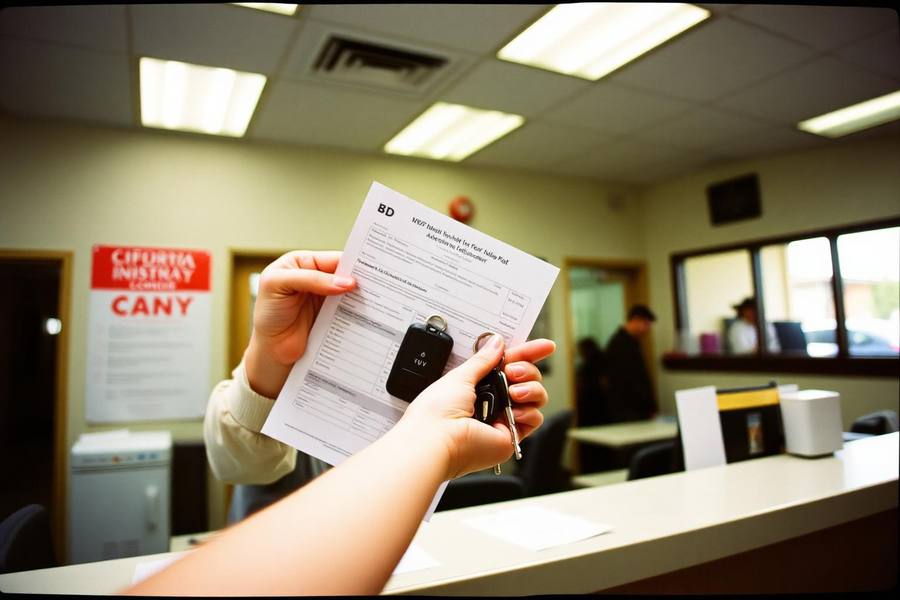
    Person holding registration paperwork and car keys at a California DMV counter under fluorescent light

    San Diego DMV Guide

    Getting a California license and registering an out-of-state car without losing a day of your life.

    Last updated

    Quick answer

    California gives new residents 10 days to register a vehicle and 10 days to apply for a California driver's license once you establish residency, though enforcement in practice is loose. The sequence that works best: book a DMV appointment online before you move (walk-ins can mean multi-hour waits), get a smog check at any STAR-certified station, then handle registration and the license in one visit. Bring proof of identity, your Social Security number, two documents proving California residency, your out-of-state license, the vehicle title, and current insurance that meets California minimums. Budget for registration fees that scale with your vehicle's value — California's are among the highest in the country, and a newer car can run several hundred dollars the first year. If you want a REAL ID, ask for it at the same visit; it requires the same documents plus an original or certified identity document.

    The new-resident checklist at a glance

    What to know
    Deadline to register a car10 days after establishing California residency
    Deadline for a CA license10 days after establishing residency
    Written test?Yes for out-of-state transfers. Study the CA driver handbook — the questions are specific
    Driving test?Usually waived if you hold a valid out-of-state license
    Smog checkRequired for most out-of-state vehicles. Any STAR-certified station
    VIN verificationRequired for out-of-state vehicles — done at the DMV or by a licensed verifier
    AppointmentsBook online weeks ahead. Walk-in waits are long, especially mid-month and Mondays
    REAL IDOptional but needed for domestic flights without a passport. Same visit, extra documents

    The order of operations

    Doing these in the wrong order is what turns a one-visit errand into three. This is the sequence that avoids getting turned away at the counter.

    1. Book the appointment first

    Appointments at San Diego-area DMV offices routinely book out several weeks. Schedule online the moment you know your move date — you can always reschedule. Showing up without one is possible but the wait is measured in hours.

    Local tip: Appointments for 'driver's license' and 'registration' are separate transaction types on the booking system. Book a combined appointment or one that covers both so you're not sent back to the queue.

    2. Get insured on a California policy

    You need liability coverage that meets California minimums before you register. Out-of-state policies often need to be rewritten for California. Do this before the DMV visit — proof of insurance is checked.

    3. Smog check

    Most out-of-state vehicles need a smog inspection at a STAR-certified station before registration. It takes 20–30 minutes and stations are everywhere in the county. Newer vehicles (within the most recent model years) and fully electric vehicles are typically exempt.

    4. VIN verification

    An out-of-state car needs its VIN physically verified. DMV staff can do this in the lot at your appointment, or a licensed VIN verifier can come to you for a fee — worth it if your appointment is tight.

    5. Registration and license in one visit

    Bring the title (or the lienholder's information if the car is financed), your out-of-state registration, smog certificate, proof of insurance, ID, SSN, and two proofs of California residency. Take the written test the same day.

    Documents to bring

    Proof of identity

    Passport or certified birth certificate. A photocopy is not accepted for REAL ID purposes.

    Social Security number

    You state it on the application; you generally don't need the card itself, but bring it if you have it.

    Two proofs of California residency

    Lease or mortgage statement, utility bill, bank statement, or employer document showing your San Diego address. If you just moved and have nothing in your name yet, a signed lease plus the first utility bill is the fastest pair to assemble.

    Local tip: Set up your utility accounts before your DMV appointment — the first SDG&E bill is one of the easiest residency proofs to produce.

    Vehicle title or lienholder info

    If your car is financed, the lender holds the title. You register with the lender's information and California requests the title from them.

    Out-of-state license and registration

    Your old license is surrendered when the California one is issued.

    Choosing an office

    San Diego County has DMV offices spread from Chula Vista to Oceanside. Location matters less than the appointment slot you can actually get.

    Book by availability, not proximity

    It is routinely faster to drive 25 minutes to an inland or North County office with next-week availability than to wait a month for a coastal one. Check several offices when booking.

    Avoid the first and last week of the month

    Registration deadlines cluster at month boundaries and lines follow. Mid-month, mid-week, mid-morning is the calmest window.

    Use online services where possible

    Renewals, address changes, and duplicate registration cards can all be handled online without an appointment. Only transactions requiring identity verification or a VIN check need an in-person visit.

    Costs to expect

    • • California vehicle registration is value-based, so a newer or more expensive car costs meaningfully more to register than an older one.
    • • There's a one-time new-resident fee for vehicles previously registered out of state.
    • • Smog checks typically run in the $40–70 range depending on the station and vehicle.
    • • Fees change; confirm current amounts with the DMV fee calculator before your visit.

    Frequently asked

    How long do I have to get a California driver's license after moving to San Diego?

    California law gives new residents 10 days from establishing residency to apply for a California driver's license, and 10 days to register a vehicle. Enforcement is inconsistent, but insurance and registration penalties make it worth doing promptly.

    Do I have to take a driving test to transfer my license to California?

    Usually no. If you hold a valid license from another U.S. state, the behind-the-wheel test is typically waived. You do have to pass the written knowledge test, which is specific enough that studying the California driver handbook is worth an hour of your time.

    Does my out-of-state car need a smog check in San Diego?

    Most do. Out-of-state vehicles generally require a smog inspection at a STAR-certified station before they can be registered in California. Very new vehicles and fully electric vehicles are typically exempt.

    Do I need an appointment at the San Diego DMV?

    Strongly recommended. Walk-in waits at San Diego County offices can run several hours, while appointment holders are usually in and out. Appointments often book weeks out, so schedule as soon as you have a move date.

    What counts as proof of California residency at the DMV?

    Two documents showing your name and San Diego address — a lease or mortgage statement, a utility bill, a bank statement, an insurance document, or an employer letter. Setting up your utility account early gives you one of the easiest proofs.

    Should I get a REAL ID?

    If you don't want to carry a passport for domestic flights, yes. It's issued at the same visit as your license but requires an original or certified identity document plus proof of your Social Security number and two residency documents.

    Keep reading

    The Sandi Spots Newsletter

    San Diego, in your inbox.

    New beach finds, hidden taco shops, weekend events, and seasonal guides — once a week from a local. No spam, ever.

    One email a week. Unsubscribe anytime.

    About this guide

    Written and fact-checked by the Sandi Spots Editorial team — San Diego residents publishing under Sleep Coast LLC. Every place we recommend has been visited in person or verified against an official source, and no business can pay for inclusion or a higher ranking. Last updated .

    Local, first-hand. Reported on the ground in San Diego County.
    Kept current. Prices, hours, and closures reviewed on a rolling basis.
    Independent. Affiliate links never influence rankings.

    Editorial policy · About us · Suggest a correction