Sandi Spots
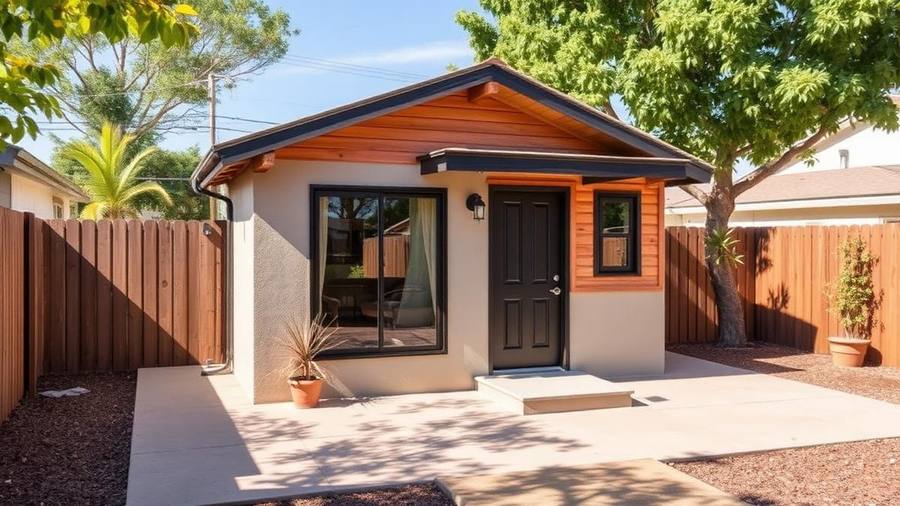
    Modern detached backyard accessory dwelling unit with stucco and wood siding in a San Diego yard

    Building an ADU in San Diego: Costs, Rules, and Choosing a Builder

    Garage conversion, prefab, or custom detached — the numbers and the permitting reality.

    Last updated

    Quick answer

    A garage conversion ADU in San Diego typically runs $120,000–$220,000, a new detached ADU $250,000–$500,000, and prefab or modular units $180,000–$350,000 delivered and set — call it roughly $350–$550 per square foot all-in for site-built work once you include design, permits, utilities, and site work. California law forces cities to allow at least one ADU and one junior ADU on most single-family lots, with four-foot side and rear setbacks, no owner-occupancy requirement for units permitted through 2025 rules, and no added parking within a half mile of transit. The City of San Diego goes further with its Bonus ADU program, which lets qualifying lots in transit priority areas build additional units in exchange for deed-restricted affordable ones — the reason you see four- and five-unit backyard projects around City Heights and North Park. Budget nine to eighteen months from first drawing to certificate of occupancy, and verify any builder's B general contractor license plus completed local ADU addresses you can drive by.

    San Diego ADU cost ranges

    Project typeTypical all-in costNotes
    Junior ADU (JADU, ≤500 sq ft, inside home)$80,000–$150,000Can share bath with main house
    Garage conversion$120,000–$220,000Cheapest path; slab and walls exist
    Attached ADU$200,000–$350,000Shares a wall with the house
    Detached new build, 600 sq ft$250,000–$400,000Most common backyard unit
    Detached new build, 1,000+ sq ft$400,000–$650,000Two-bedroom scale
    Prefab / modular$180,000–$350,000Plus site work, foundation, utilities
    Cost per square foot (site-built)$350–$550Includes soft costs
    Design and engineering$8,000–$25,000Pre-approved plans cost far less
    Permits and city fees$5,000–$20,000Many impact fees waived for ADUs under 750 sq ft
    Utility connections / panel upgrade$5,000–$30,000Sewer lateral and electrical are the wild cards
    Typical timeline9–18 monthsDesign, permit, build

    The rules that make San Diego ADUs unusual

    State minimums apply everywhere

    California requires most single-family lots to allow one detached ADU up to at least 800 sq ft plus one junior ADU, with four-foot rear and side setbacks and 16-foot minimum height allowances. Cities cannot impose lot coverage or FAR limits that would block an 800 sq ft unit.

    The City of San Diego Bonus ADU program

    In transit priority areas, building deed-restricted moderate-income ADUs unlocks the right to build additional market-rate ADUs on the same lot. This is why some city lots support four, six, or more units — it is the most permissive ADU framework in the state and it has been actively debated and amended, so confirm current rules before designing around it.

    No added parking near transit

    If the property is within half a mile of public transit, the city cannot require replacement parking, including when you convert a garage.

    Impact fee relief

    ADUs under 750 sq ft are exempt from most development impact fees statewide, which is a major reason so many units land right at 749 sq ft.

    Coastal Commission areas

    Properties in the coastal zone may need a coastal development permit on top of the building permit, adding months. This affects much of La Jolla, Pacific Beach, Ocean Beach, and Point Loma.

    Fire and access

    Hillside and very high fire hazard severity zone lots face sprinkler, access width, and defensible space requirements that change the budget. Get this checked before design.

    Separate sale is limited

    ADUs generally cannot be sold separately from the main house except through specific affordable-housing pathways. Plan on rental income or family use, not a condo sale.

    Money: what it costs and how people pay for it

    The hidden costs that blow budgets

    Sewer lateral capacity, an electrical panel upgrade to 200 amps, long utility runs across a deep lot, grading on a slope, and soils reports. Ask every builder to price these explicitly rather than as allowances.

    Pre-approved plans

    The city maintains a set of pre-approved ADU standard plans that cut design cost and shorten plan check considerably. If a standard plan fits your lot, it is the fastest and cheapest route.

    Financing

    Common paths are cash-out refinance, HELOC, renovation loans, and construction-to-permanent loans. Some lenders will underwrite against projected ADU rental income; most will not, so ask early.

    CalHFA and grant programs

    State ADU grant funding for pre-development costs has opened and closed with budget cycles. Check current availability rather than assuming it exists.

    Rental math

    A one-bedroom detached ADU in a decent San Diego neighborhood rents in a broad range depending on area and finish. Run your own comps on current listings — do not accept a builder's pro forma as fact.

    Property taxes

    An ADU triggers a supplemental assessment on the new construction value only; it does not reassess your whole property. That is a meaningful advantage over buying a second property.

    Insurance

    Tell your insurer before construction and add the unit to the policy afterward. A rented ADU changes coverage requirements.

    Choosing an ADU builder

    Ask for local ADU addresses

    Any real ADU builder can name completed San Diego projects you can drive past and owners you can call. Permit-history experience with your specific city matters more than glossy renderings.

    Design-build vs. separate architect

    Design-build is simpler and usually faster; hiring an architect separately gives you competitive construction bids on one set of plans. Both work — the mistake is having no clear owner of the permit process.

    Who runs plan check

    Confirm in writing that the builder handles submittal, corrections, and resubmittal. Plan check cycles are where months disappear.

    Fixed price vs. cost-plus

    Fixed price with a defined allowance schedule protects you. If it is cost-plus, insist on an open book and a not-to-exceed number.

    Prefab tradeoffs

    Modular units shorten on-site time but you still pay for foundation, utilities, crane access, and site work — often $60,000–$120,000 beyond the unit price. A narrow lot with no crane access can rule prefab out entirely.

    Payment schedule and liens

    Progress payments tied to inspections, a 10% retention until final, and conditional lien releases from every sub at each payment. This is the standard that keeps you out of trouble.

    Verify the license and insurance

    A B general contractor license active on cslb.ca.gov, with a current bond, general liability, and workers' comp certificate naming you.

    Before you sign anything

    • • ADU rules in California and in the City of San Diego have changed repeatedly in the last several years, including active debate over the Bonus ADU program. Confirm current standards with the City of San Diego Development Services Department or your city's planning counter before you design around any specific allowance.
    • • Costs here are typical San Diego County ranges. Slope, soils, utility distance, coastal zone review, and fire zone requirements move them substantially.
    • • Verify the license at cslb.ca.gov and confirm the classification, bond, and workers' compensation are current.
    • • California caps the down payment on a home improvement contract at $1,000 or 10% of the contract price, whichever is less.
    • • This is general information, not legal, tax, or financial advice. Talk to your lender and a tax professional before committing to a project of this size.

    Frequently asked

    How much does it cost to build an ADU in San Diego?

    A garage conversion typically runs $120,000–$220,000, a new detached ADU $250,000–$500,000, and a prefab unit $180,000–$350,000 plus site work. Site-built work averages roughly $350–$550 per square foot all-in including design, permits, and utilities.

    What is San Diego's Bonus ADU program?

    It is a City of San Diego incentive that lets properties in transit priority areas build additional ADUs beyond state minimums in exchange for deed-restricting some units as affordable. It has produced multi-unit backyard projects across the city and has been amended repeatedly, so confirm current rules before designing to it.

    How long does it take to build an ADU in San Diego?

    Plan on nine to eighteen months from first design meeting to certificate of occupancy — roughly two to four months of design, two to six months of plan check and permitting, and four to eight months of construction. Coastal zone properties take longer.

    Do I need extra parking for an ADU?

    Not if the property is within half a mile of public transit, and cities cannot require replacement parking when you convert a garage in those areas. Outside transit areas, check your city's current standard.

    Can I sell my ADU separately?

    Generally no. ADUs are usually tied to the main property and cannot be sold off individually except through narrow affordable-housing pathways. Most owners build for rental income, family housing, or resale value.

    Will an ADU reassess my property taxes?

    Only the new construction is assessed and added to your existing base — the whole property is not reassessed at current market value. That blended treatment is one of the main financial arguments for building rather than buying a second property.

    Is a garage conversion cheaper than a new detached ADU?

    Usually by a wide margin, since the slab, walls, and roof already exist. The savings shrink if the slab needs replacing, the structure lacks a proper foundation, or long utility runs and a panel upgrade are required.

    Keep reading

    The Sandi Spots Newsletter

    San Diego, in your inbox.

    New beach finds, hidden taco shops, weekend events, and seasonal guides — once a week from a local. No spam, ever.

    One email a week. Unsubscribe anytime.

    About this guide

    Written and fact-checked by the Sandi Spots Editorial team — San Diego residents publishing under Sleep Coast LLC. Every place we recommend has been visited in person or verified against an official source, and no business can pay for inclusion or a higher ranking. Last updated .

    Local, first-hand. Reported on the ground in San Diego County.
    Kept current. Prices, hours, and closures reviewed on a rolling basis.
    Independent. Affiliate links never influence rankings.

    Editorial policy · About us · Suggest a correction